


Watch: How F1 Teams Make $186K Front Wing: “If It’s Not Perfect, a Week’s Worth of Work Could Be Wasted”

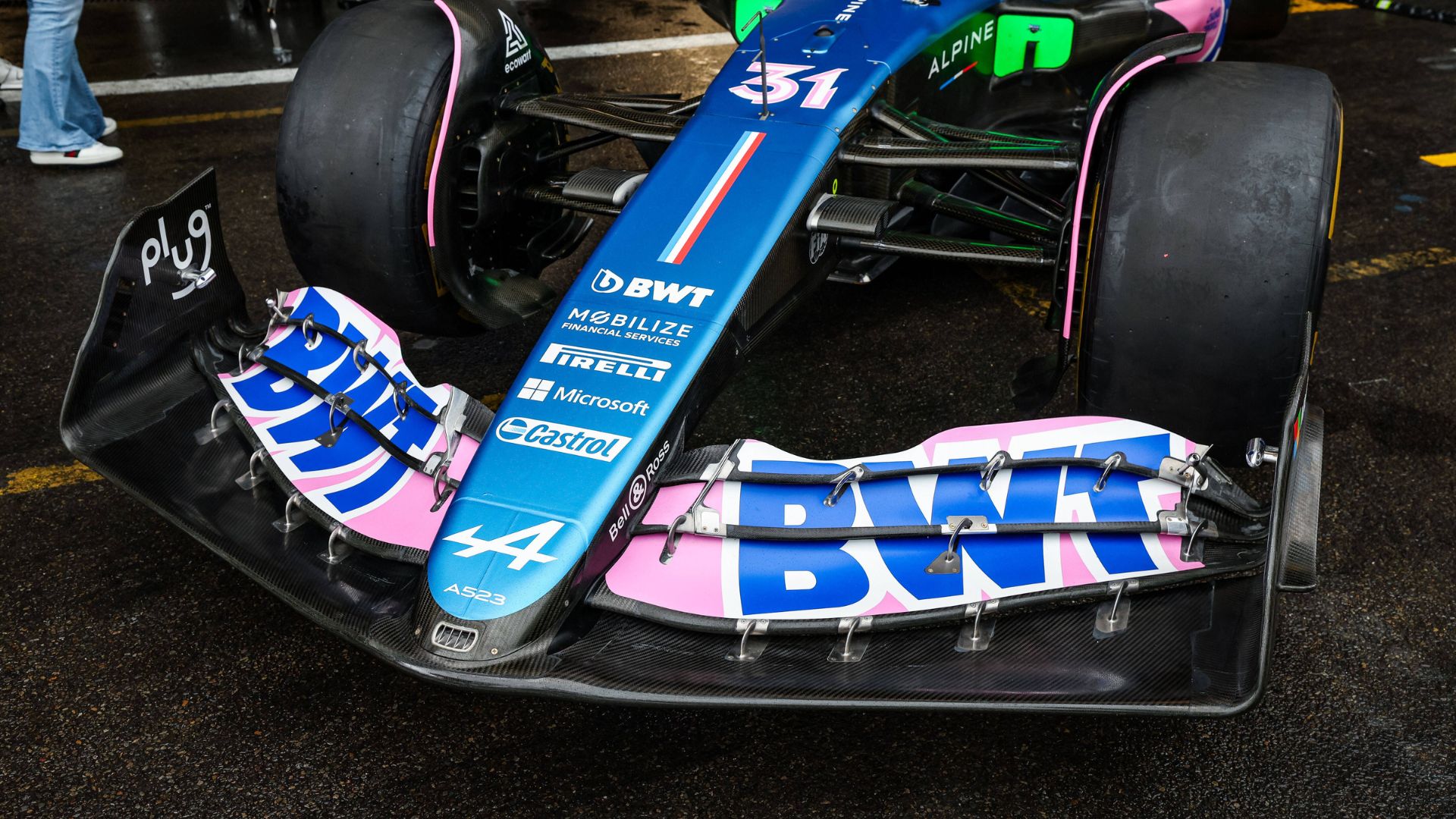
Each part of an F1 car such as the front and rear wings, the floor, brake calipers, the side pods, and suspensions has its unique design characteristics and costs a significant amount from a team’s budget. The design and production process of these parts is always kept under wraps by the teams.
Former racer Scott Mansell, however, got a chance to see and understand the manufacturing process of a front wing, which can cost around £150,000 (~$186,000) for any team. Mansell visited the Alpine F1 factory in Enstone to witness the production of a front wing made from raw carbon fiber.
He highlighted how it can take up to seven days to finish a front wing from scratch. The process initially begins with creating a carbon fiber mold, which is “three times thicker than the actual wing itself”, Mansell said in his video post on Instagram.
“Each layer of carbon is precision cut by a computer and then laid up by hand. Using a special laser system, technicians project exactly where each piece needs to go. And the first layer is absolutely critical. If it’s not perfect, a week’s worth of work could be wasted,” he added.
Carbon fiber is a rather soft and flexible material in its raw form, but has immense tensile strength, almost three times that of steel. So, it can easily be misplaced in the mold, which can ruin the shape of the front wing, forcing the team to discard it.
View this post on Instagram
However, once they vacuum seal it, the front wing is placed in a “pressurized oven called an Autoclave” to bake and finish it for fitting it on the car. Overall, the amount of technology, manpower, and expensive raw material required to produce a front wing justifies its expensive cost of $186k.
Mansell explained how F1 teams test new parts in a simulator
Besides visiting Alpine to learn about front wings, Mansell also visited a top-end simulator manufacturing company called Dynasma. In another video of his on Instagram, the British former driver explained how the company manufactures highly accurate racing simulators which are more than useful for F1 teams.
While he did not talk specifics about the top-end model of simulators that F1 teams actually use, Mansell gave his insights on a £2.5 million (~$3.1 million) worth simulator that is as accurate as the one used by the teams. These simulators are highly accurate due to their “incredibly low latency”.
“Just 3 milliseconds between driver input and simulator response. That’s about 10 times faster than other simulators,” Mansell said. Due to this lag-free simulator experience, drivers get an almost real-life-like experience while virtually driving the car.
View this post on Instagram
On top of that, teams can plug in the data from a new part they have produced and tested using CFD and the wind tunnel into the simulator. “Then the driver can instantly feel how the car behaves with the new components,” Mansell added.
As a result, teams get instant feedback from drivers and the simulator data about how good is their new part. Due to the accuracy of the simulator, teams can be confident whether their new part will give them the results they desire or not.
About the author


-

Anirban Aly Mandal •
“The Team Would Never Let Me Win”: Jarno Trulli Blames Flavio Briatore-Fernando Alonso Nexus for 2004 Debacle
-

Aishwary Gaonkar •
“They Think I’m an Idiot”: Ted Kravitz Accepts -7 Rating on His F1 Show With Jacques Villeneuve
-

Anirban Aly Mandal •
Esteban Ocon Reveals Physical Deformity Common Among F1 Drivers: “One of the Dark Sides of Driving”
-

Anirban Aly Mandal •
Esteban Ocon Tells Why He Would Never Go to a Kebab Shop With Ciryl Gane Again
-
Anirban Aly Mandal •
Victim of Franz Hermann’s GT Car Superiority Empathizes With F1’s Lando Norris
-

Somin Bhattacharjee •
“There Is No One-Size-Fits-All Solution”: Red Bull Chief Engineer Urges ‘Lower Expectations’ for Imola Upgrades