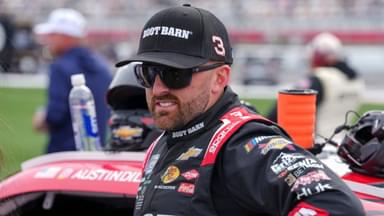
The Atlanta Motor Speedway has morphed into a mini superspeedway, even though it still falls into the intermediate bracket by length. After the 2022 overhaul, banking was increased from 24 to 28 degrees, with the track now leaning heavily into drafting. The shift has changed how races unfold there compared to the past. Austin Dillon, who holds an average finish of 21.0 at the track across 18 starts, recently weighed in on how racing has evolved at EchoPark Speedway.
Advertisement
After the changes, the track now stands as the steepest on the NASCAR intermediate circuit. The width shrank to 40 feet in the turns, 42 on the backstretch, and 52 on the front stretch to bunch the field and stir pack racing. The surface saw its first repave since 1997, with an Open Drainage Layer laid in to move water off the racing groove.
Beyond that, the transition apron climbed to 18 degrees, and the front stretch wall saw a redesign to smooth the exit from Turn 4 and boost safety. Dillon said as per Speedway Media, “I think EchoPark Speedway is gaining character JO from the winters, and just the passing time.
“That place is so banked, and you’re starting to find little bumps and stuff that were in it from the beginning that are getting bigger.”
“It’s a cool style of racing. It’s a lot different than what we all envisioned a repave of EchoPark Speedway would be. It’s speedway racing, but with an important handling component. Handling is going to become more and more important as the track wears. I had a lot of fun in previous races there, even though we’ve been caught up in some messes,” he continued.
The Richard Childress Racing driver also pointed out how easy it is to get swept into someone else’s trouble at EchoPark Speedway. Two years ago, he felt he had his best shot there, only for a wreck to pull the rug out from under his run. When cars are running within a car length, dodging chaos becomes a roll of the dice at that place.
In fact, the same thing happened to him at Daytona as well. Dillon went into that weekend with wind in his sails, topping the second practice at 195.627 mph. He qualified 12th and lined up seventh after a third-place Duel finish. Then came Lap 85, when a nine-car chain reaction on the front stretch turned the day upside down.
The wreck started with Cody Ware making contact with Chase Briscoe, sending Briscoe around. Dillon had nowhere to go and T-boned the spinning car in the infield. The hit knocked the wind out of his No. 3 RCR Chevrolet Camaro ZL1. With the damage sealing the deal, Dillon had to park his car behind the wall, his race done after 137 laps in P37.