


NASCAR Trivia: How Near Flat Tires Help Drivers Start Short Track Races on the Right Foot

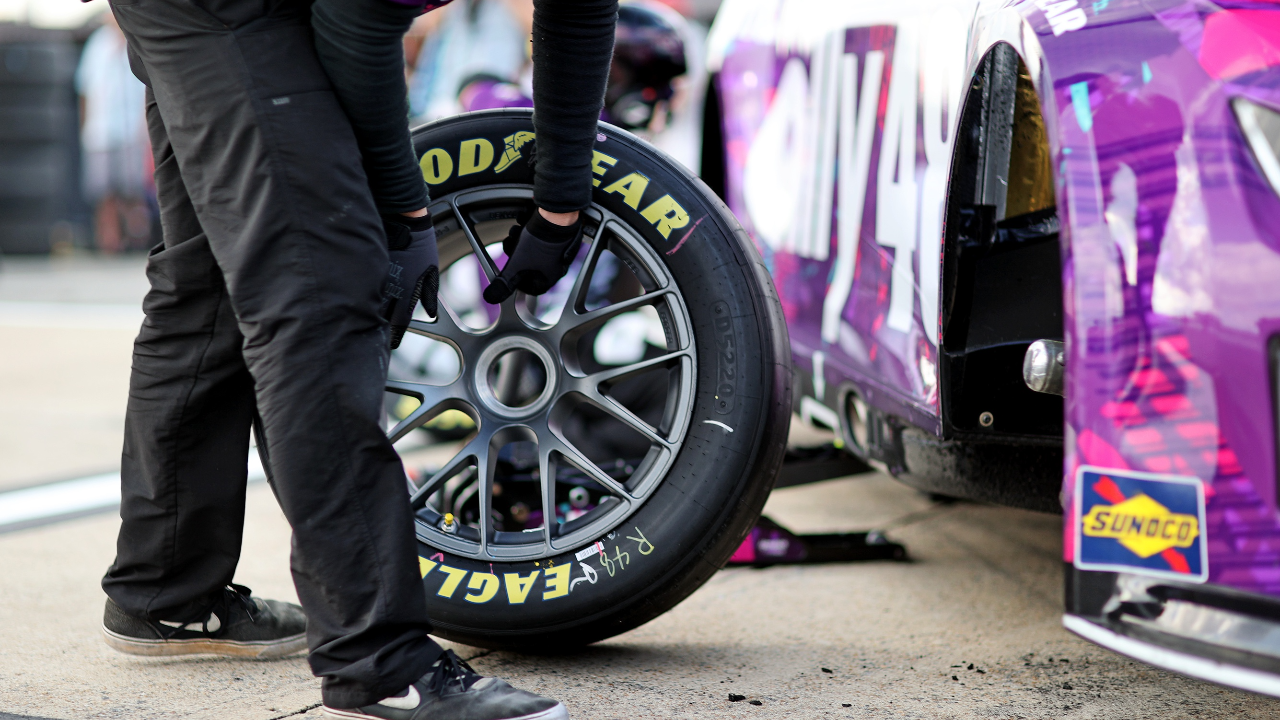
Since time immemorial, tires have played a crucial role in motorsports. Behind all the talk about aerodynamics and driver talent, four pieces of rubber dictate how races pan out and how legacies are left behind in racing. Owing to the black art of tire preparation, there are several tricks race teams employ that allow drivers the best chance to go out and perform.
However, starting a race with nearly flat tires is one of the more bizarre instances of the same. Despite how counterintuitive it may sound, short-track events in the world of stock car racing such as races at Martinsville Speedway and Bristol Motor Speedway always see teams and drivers start with tires that look squished as if they were leaking air.
The science behind doing so is simple. The more rubber there is in contact with the asphalt, the more grip a tire will offer its driver. Thus, teams often run bare minimum pressures to allow their tires to squish down and bite into the asphalt with as much surface area as possible, in turn offering the maximum possible grip to the driver.
However, the reason why drivers and teams start with lower-than-ideal pressures during race starts is the phenomenon of how pressure inside a tire increases along with its temperature as it is used during race conditions.
Goodyear’s softest tires ever left rubber EVERYWHERE at Martinsville@JoeGibbsRacing shared the aftermath on TikTok pic.twitter.com/cX2lDWtl9c
— BrakeHard (@BrakeHardBlog) November 8, 2024
Teams calculate the optimal pressure a tire should run at during the race before the start and estimate how much it is bound to increase as the green flag drops to accurately give their driver the best possible chance of competing throughout a run. This helps teams extract the best possible handling from their machines throughout an event while maintaining a controlled increase in tire pressure.
Short-track events often see pressures in the 18-inch Goodyear rubber start in the single digits, with the same rising to optimal levels as racing starts. Teams are also seen pushing the boundaries of how low they can go with pressures in pursuit of ultimate grip at superspeedway events, often leading to catastrophic tire failures on the track.
To avoid such practices, NASCAR often mandates a minimum recommended pressure for teams to run at various tracks, discouraging them from gaining on-track performance at the cost of the safety of their driver and machine, along with others around them.
Tire strategy will be crucial in this final #NASCAR Cup Series race. With teams racing on a well known tire set-up, though not the same set-up ran earlier in the season at @phoenixraceway, past experience will be invaluable. pic.twitter.com/1KbDiD1oRn
— Goodyear Racing (@GoodyearRacing) November 9, 2024
For example, Goodyear mandated a minimum recommended pressure of 20 and 22psi for the left front and left rear tires during the 2022 Coca-Cola 600 at Charlotte Motor Speedway after extensive load testing with how the Next Gen Cup car interacts with its tires.
All in all, it is often said that motorsports, especially NASCAR, boils down to a game of high-speed chess on the track and a competition of engineering off it. With the intricacies of tire inflation often making the difference between a winning racecar and a crash, the same certainly holds today.
About the author


-
Anirban Aly Mandal •
“It Was a Shame”: NASCAR Star Ryan Blaney Was Once Starstruck By NBA Legend Kobe Bryant
-
Neha Dwivedi •
‘I Am In Favor But…’: Jeff Gordon Highlights Key Challenge Ahead of NASCAR’s International Foray
-
Gowtham Ramalingam •
WATCH: Chase Briscoe Reacts in Awe as Tyler Reddick Shaves off His Mullet Ahead of Martinsville
-
Soumyadeep Saha •
Kevin Harvick’s Prediction for HMS and Penske Heading Into Las Vegas, Picks Surprise Winner
-
Soumyadeep Saha •
“Best Place I’ve Ever Worked”: NASCAR Crew Chief Relives Clint Bowyer’s Dream 2012 Season
-
Gowtham Ramalingam •
The Weight of Underperformance Is Wearing on Tyler Reddick—and It Shows