
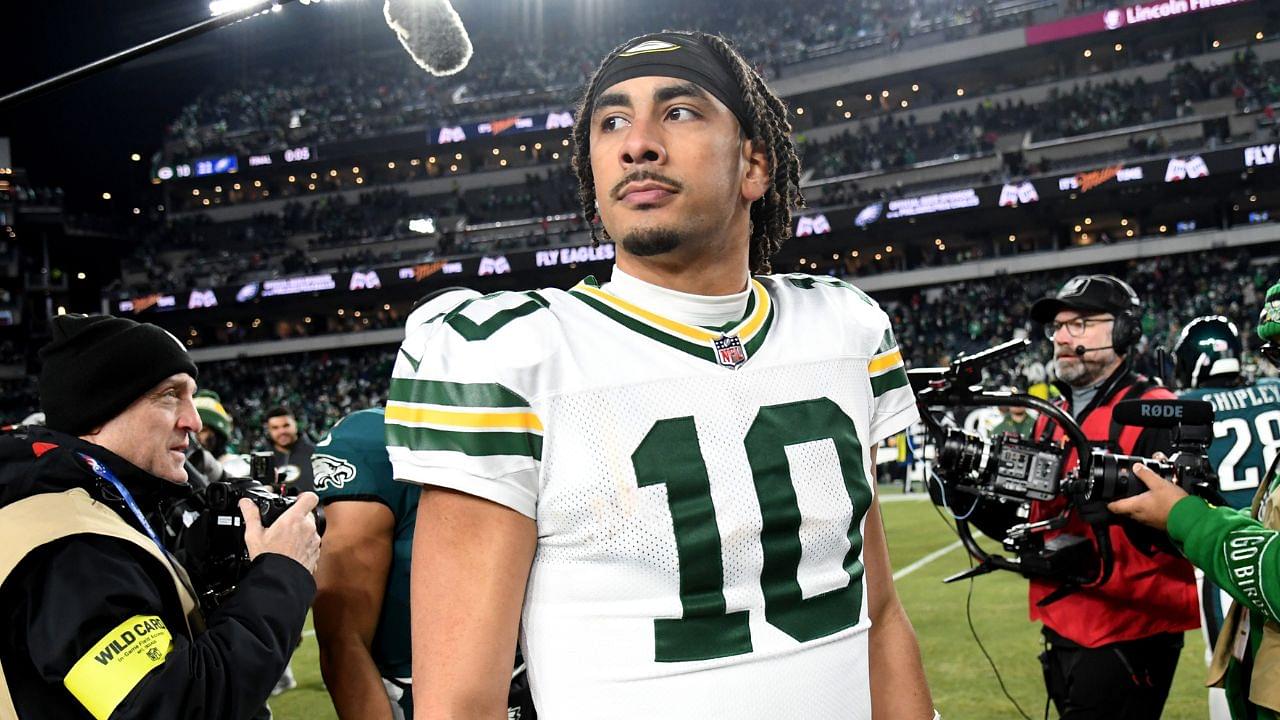
The Green Bay Packers have spent the better part of three decades moving from one franchise quarterback to the next without ever enduring a true rebuild. From Brett Favre to Aaron Rodgers and now to Jordan Love, the expectation in Green Bay has never been mere stability at the position. It has been sustained, high-level quarterback play.
Advertisement
That history is part of why Love’s development continues to be examined under a harsher microscope than most young starters, even after a season that, by several advanced metrics, placed him among the league’s most efficient passers.
That context framed Kay Adams’ recent defense of the Packers quarterback, as she revisited Green Bay while discussing the team’s quiet offseason and the broader conversation around Love’s standing in the league. Adams acknowledged that the Packers have not made splashy additions on offense, but argued that the lack of urgency says more about their belief in Love than any roster limitations.
“We haven’t talked about the Packers in a minute,” Adams said. “Maybe Packers fans think that I abandoned them… they know I’m obsessed with Caleb Williams, they don’t really say anything when I say that.”
She pointed out that the team’s most notable moves have come on defense and along the interior, referencing additions such as Javon Hargrave and veteran linebacker help, before shifting the focus back to the quarterback.
“Offensively, maybe we don’t need to add that much. That’s sort of what I’m thinking because if you do look at Jordan Love… he did take a leap.”
Adams’ argument was not based on narrative or highlight plays. Instead, she leaned on advanced metrics, specifically expected points added per dropback, to support her claim that Love’s 2025 season represented a tangible step forward.
“He did lead the entire NFL in expected points added per drop back this year,” she said. “And if you’re like, what is that… here’s my understanding of it. It’s like the go-to analytic for evaluating quarterback play because it measures the success rate of the team each time a passing play is called and which quarterbacks are ultimately putting their offense in the best position to score some points.”
By emphasizing EPA rather than traditional counting stats, Adams highlighted why Love’s season may have been undervalued in broader discussions. Green Bay leaned heavily on its ground game in the red zone, which limited Love’s touchdown totals and dulled his box score impact, but play-to-play efficiency painted a much stronger picture of his performance.
Adams also acknowledged the uneven ending to Green Bay’s season, which has likely shaped public perception more than the totality of Love’s body of work.
“I’m not trying to sugarcoat what was a wooftastic end of the season,” she said. “The overall body of work from Jordan singularly was actually very impressive.”
That distinction between team results and individual efficiency sits at the center of the current debate around Love. Some national rankings have continued to place him outside the league’s top tier, citing inconsistency and a lack of gaudy statistics. Others, particularly those who prioritize advanced metrics and down-to-down grading, view his 2025 campaign as clear evidence that he has moved beyond the developmental phase of his career.
Love’s growing visibility off the field has also kept him in the public eye as the new season approaches. He is set to throw out a ceremonial first pitch at the Milwaukee Brewers’ Opening Day, a return appearance after a widely joked-about effort last year. While largely symbolic, the moment reflects how the franchise is positioning him as one of the faces of Wisconsin sports, a role historically reserved for its established stars.