
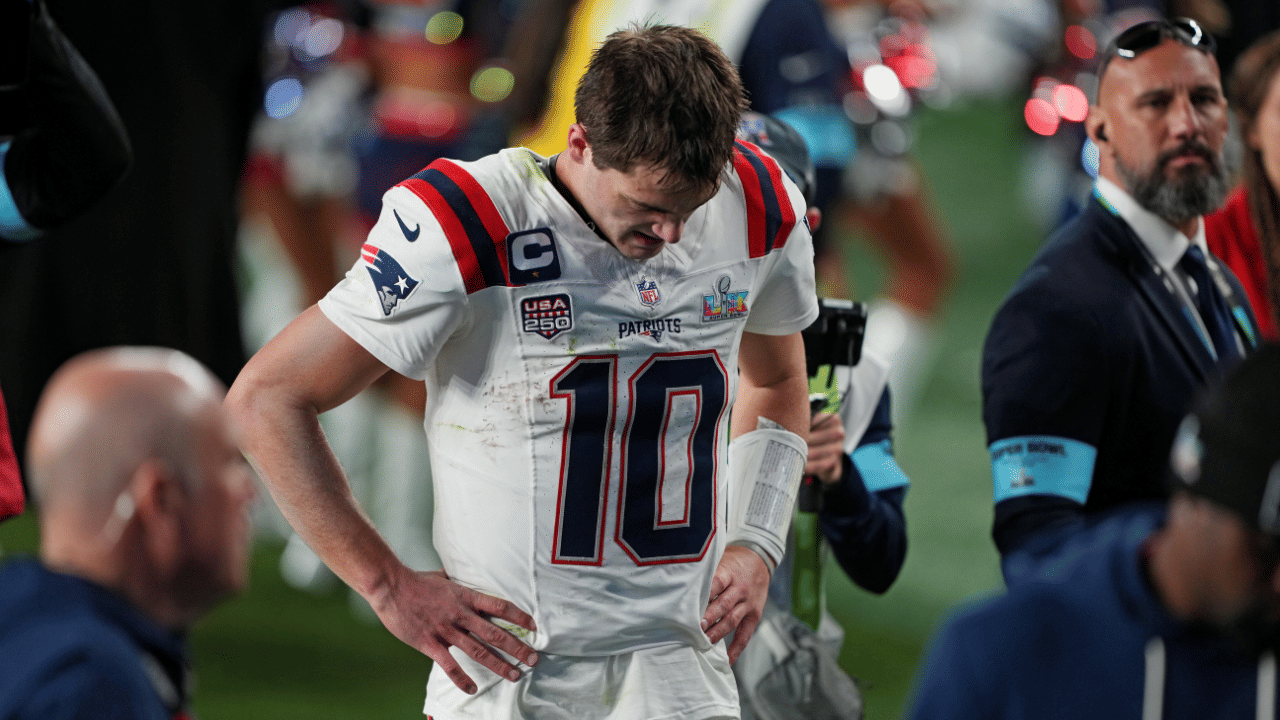
Neither quarterback was spectacular in Super Bowl LX. However, Sam Darnold delivered a steady, mistake-free performance to outshine Drake Maye and lead the Seattle Seahawks to a 29-13 victory over the New England Patriots. What stood out as a difference was Darnold’s ability to protect the football and manage the game. Maye, meanwhile, was overwhelmed by pressure.
Advertisement
The contrast between the two quarterbacks was evident from the opening drive. Darnold avoided risky throws and capitalized on the favorable field position created by Seattle’s defense. Maye, on the other hand, spent much of the night scrambling for survival, absorbing hits and struggling to find rhythm.
The difference between the two QBs shaped the entire contest and framed much of the postgame discussion. Since the game, most have agreed that the much-expected defining moment in Maye’s career turned into a harsh lesson on the sport’s biggest stage. Then again, did he play that badly? Well, former MVP Cam Newton has offered one of the most honest and detailed evaluations of his performance.
Speaking about the game, Newton acknowledged that Darnold was not at his peak. He did enough to win. “Sam didn’t play his best game,” said the Panthers legend. “But he played a good game. Good enough for them to win. Yes, sir.”
Newton then turned his focus to Maye, delivering a nuanced assessment rather than a harsh critique. “And the truth is, Drake didn’t necessarily play a bad game,” Cam explained. “He just played bad enough to lose the game. He’s played worse games, and they found ways to win. And that’s the truth.”
According to Newton, the context of the opponent mattered just as much as Maye’s individual mistakes. “That wasn’t a lesser opponent,” he said. “They was strapped and ready to go. That was probably the first team they played at their best in two months.”
Seattle’s preparation and defensive intensity showed up in the statistics. Maye was sacked six times, pressured on 19 dropbacks, and watched his offense go scoreless in the first three quarters. The Patriots managed only 58 yards in the first half and failed to score on their first 10 possessions.
“And the Patriots, man,” Newton added, “they scored no points in the first three quarters. Had 58 total yards in the first half. Unacceptable.”
Despite the poor numbers, Newton refused to single out Maye as the sole reason for the loss. He emphasized that responsibility was spread across the entire offense.
“Everybody wants to point to Drake,” Newton said. “Everybody wants to point to Will Campbell. Everybody wants to point to Josh McDaniels. Everybody wants to point to the whole offense. But it’s enough blame to go around.”
Newton cited multiple breakdowns that left Maye in impossible situations. “We didn’t adjust. We didn’t have in-game adjustments,” he continued.
“We didn’t run the football properly. Our receivers didn’t get separation. From the protection to separation, it wasn’t too much that Drake Maye could do,” added Newton, who felt that the lack of adaptability was just as damaging as the physical pressure.
Maye was too rigid
Seattle consistently changed looks, disguised coverage, and forced New England into uncomfortable third-down situations. Without effective counters, the Patriots’ offense stalled repeatedly.
Still, Newton made it clear that great quarterbacks are judged by how they respond when everything breaks down. “This is what makes elite players elite players,” he said. “Good players play good. Great players play great. When we need you to be elite, this is the moment.”
The former Heisman winner stressed that leadership and playmaking must replace finger-pointing in moments like these. “Let’s take turns making plays,” he said, “not taking turns pointing blame.”
Newton then summarized his message with a metaphor that quickly went viral. “Sometimes you can be invited to the party,” he said, “but the true question is, can you dance? The Super Bowl dance is a little different. That’s with the big stars.”
Seattle’s defensive game plan made that “dance” nearly impossible for Maye. Throughout the season, scouts had praised Maye’s arm strength and fearlessness. However, some experts also noted that his approach to reading defenses was structured to the point of being rigid. Rather than reacting instinctively, Maye often followed the script of the play too rigidly.
By collapsing the pocket and disguising coverages, Seattle disrupted that structure. Instead of moving fluidly through his reads, Maye appeared locked onto his first option. The hesitation gave defenders extra time to close throwing lanes and apply pressure.
Beyond Maye’s decision-making, the Patriots’ offensive structure also collapsed. The offensive line struggled to handle blitzes and stunts, particularly on the left side. Play-calling failed to create easy completions, and receivers rarely generated clean separation.
Within Josh McDaniels’ system, Maye struggled to adjust once Seattle neutralized his primary options. Without a consistent rhythm, the offense fell into long-yardage situations and predictable patterns.
While New England unraveled, Darnold delivered exactly what Seattle needed.
Darnold’s clean act during the playoffs
After leading the league in turnovers during the regular season, Darnold finished the postseason without a single giveaway. Sam stayed patient, avoided unnecessary risks, and let his defense dictate the game.
Seattle’s defense, meanwhile, produced one of the most dominant Super Bowl performances in recent memory. The unit forced eight punts and three turnovers, held New England to 78 yards through three quarters, and allowed only one late touchdown. Their dominance paved the way for Kenneth Walker III to win the Super Bowl MVP award.
After the loss, Maye spoke quietly but honestly about the disappointment. “Definitely hurts,” he said. “They played better than us tonight.”
Despite receiving a pregame injection for a shoulder injury, Maye refused to use it as an excuse. “I wouldn’t put the team in harm’s way to not be myself,” he said. “Just didn’t make plays tonight.”
Losing a Super Bowl debut can be difficult to overcome. Only a small number of quarterbacks have returned to win after falling short the first time. However, Newton’s assessment suggests that this loss does not define Maye’s career. Instead, it exposes what must change.
To take the next step, Maye must speed up his internal clock, trust anticipation over confirmation, and develop greater situational patience. Better protection and smarter adjustments will help, but growth ultimately depends on how he responds to this setback.
Super Bowl LX was supposed to mark Maye’s arrival as the unquestioned future of the Patriots. Instead, it became a reminder of how unforgiving the championship stage can be.
As Cam Newton put it, Maye earned his invitation to the party. The next challenge is proving that he’s ready to dance, if and when he returns.