
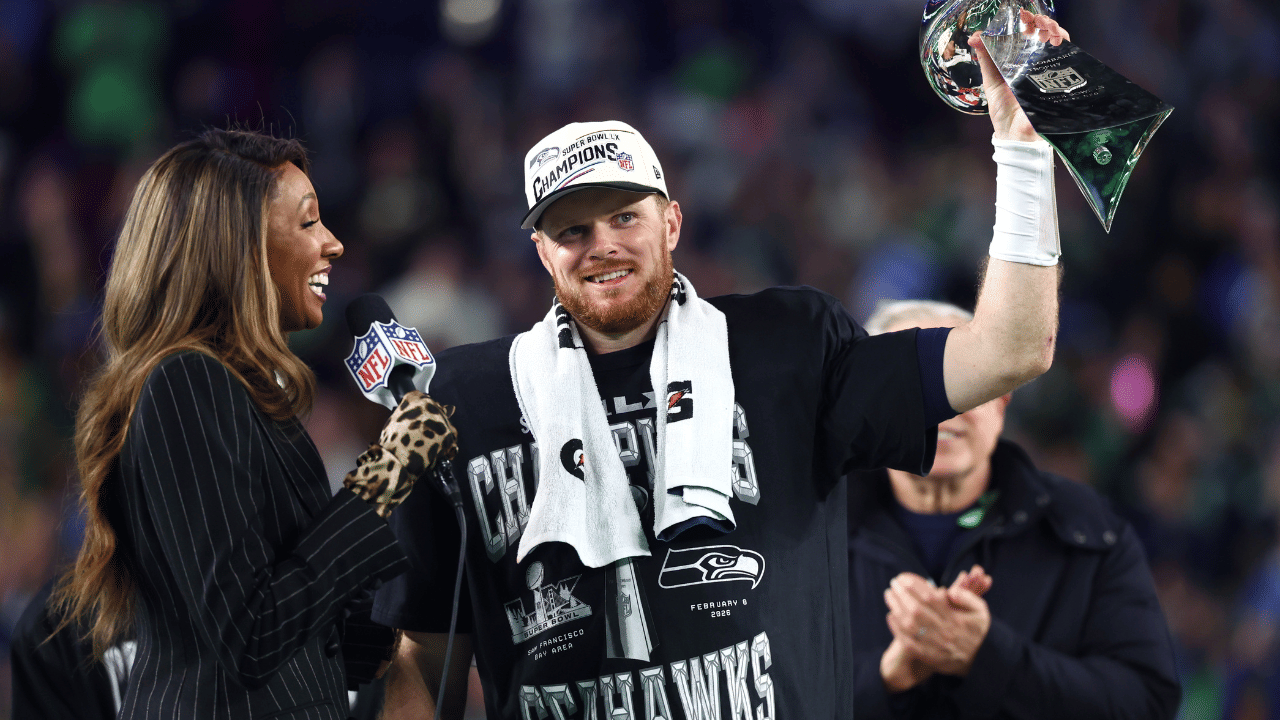
When the Seattle Seahawks finished their season with a Super Bowl LX victory over the New England Patriots, the defining feature of their championship was not a single play or dominant stretch. It was the absence of the mistakes that had followed them for much of the year.
Advertisement
Over the entire postseason, Seattle did not commit a single turnover, an achievement no team had previously managed. For a roster that entered January with a negative turnover differential, the transformation was striking.
Jason Kelce pointed directly to that shift while discussing the game on ‘New Heights.’ Reflecting on the matchup, Kelce emphasized how complete Seattle looked throughout the postseason, particularly on defense.
“Both of their defenses had been playing out of their minds all postseason,” he said. “Seattle is just loaded across the board. They don’t really have a weakness.”
While he acknowledged that New England had been well coached and had overachieved under Coach Ves and Josh McDaniels, Kelce felt Seattle’s depth and balance ultimately created separation. “It felt like they were the more talented group across the board,” he said. “Seattle just proved to be a little bit too much.”
Beyond the defense, Kelce highlighted the improvement of Sam Darnold as one of the central reasons the Seahawks were able to finish the job. During the regular season, turnovers were a recurring issue for Seattle’s offense, and Darnold was often at the center of those struggles.
Interceptions and fumbles came in clusters, keeping opponents in games and fueling doubts about whether he could lead a team deep into the postseason. That pattern disappeared in January.
“Offensively, they didn’t make the mistakes they had kind of been prone to,” Kelce said. “Sam Darnold had a bunch of turnovers in the regular season. He doesn’t have any in the postseason.”
What stood out most to Kelce was that the change did not come from playing cautiously. “He didn’t do that by being conservative,” he added. “He was still taking his chances. He was still being aggressive through the air.”
Much of that growth appeared to begin late in the regular season. Seattle’s overtime win over the Rams, in which Darnold threw two interceptions but still led a 38–37 victory, served as an early sign that he was learning how to manage adversity without losing confidence.
The following week against Carolina was uneven in difficult conditions, but once the team returned to its routine, Darnold’s play stabilized. From that point forward, he protected the football against every postseason opponent, including San Francisco, Los Angeles, and New England. The mistakes that had once defined his season were no longer part of Seattle’s identity.
Another factor that illustrated Seattle’s dominance was how rarely they were forced to play from behind. Throughout the entire postseason, the Seahawks trailed for only one minute and 35 seconds. Kelce called the statistic “insane,” noting how consistently Seattle jumped out to early leads and maintained them.
From blowout wins over San Francisco to their rematch with the Rams and the Super Bowl itself, the Seahawks controlled game flow and dictated tempo. Playing from ahead allowed Darnold to operate within the system, trust his reads, and avoid unnecessary risks.
For Darnold, the playoff run represented a turning point in his career. After years marked by inconsistency and criticism, he delivered his most reliable football when the stakes were highest. He remained aggressive, avoided costly mistakes, and guided Seattle through four pressure-filled games without giving opponents extra opportunities.