
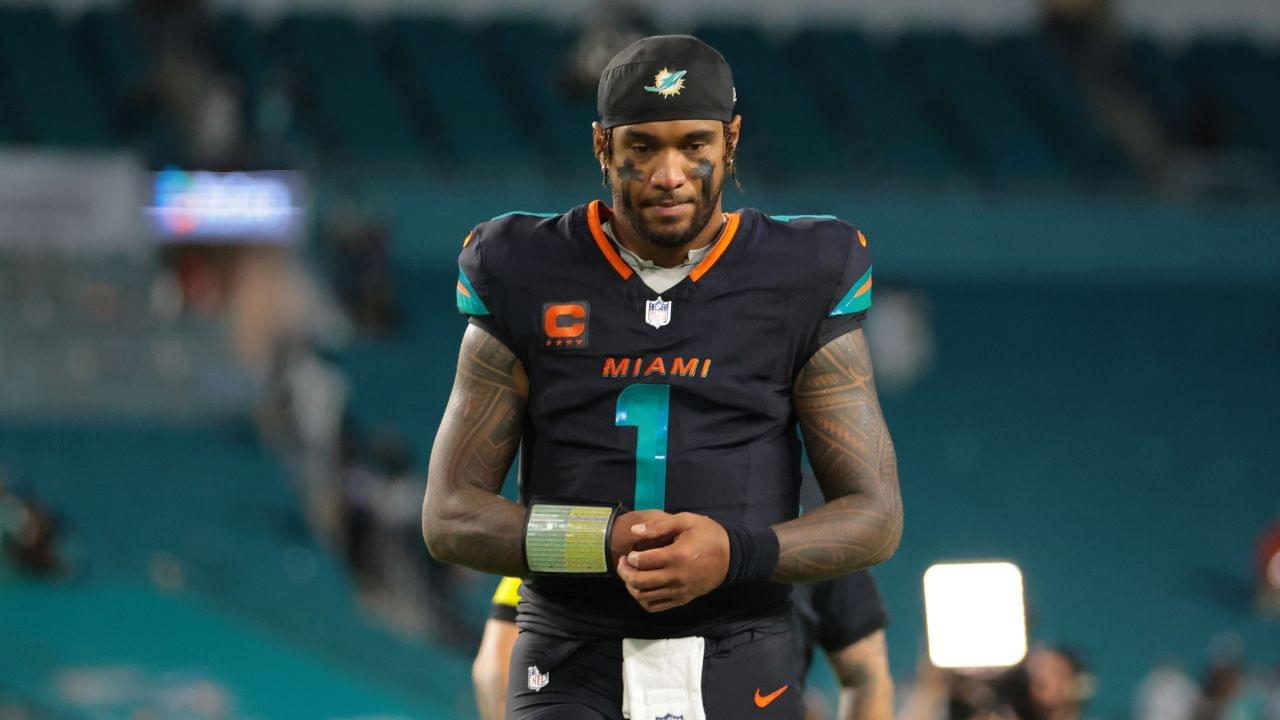
When the Miami Dolphins released Tyreek Hill, it sent shockwaves through the league. The wide receiver had been the centerpiece of Miami’s explosive offense, the vertical threat who helped unlock the full potential of Tua Tagovailoa. And letting him go was not just a football decision.
Advertisement
Hill’s release was a financial reset and a signal that major changes are underway in the 305. No one captured the tension within the team ranks quite as well as Cam Newton.
Newton framed Hill’s exit as part of a broader organizational shift, hinting that Miami is effectively hitting reset. “They [are] just bagging up,” Newton said.
The Panthers legend painted a picture of a franchise ready to reshape itself, implying that anyone tied to the previous vision could be on borrowed time. Newton even speculated that if the teardown continues, other familiar names could follow Hill.
In his view, this is not just roster trimming. It is regime change energy. A team retooling “their way,” even if it means dismantling the core that once defined the offense. Newton got especially candid while discussing Tagovailoa’s contract.
After Hill’s release reportedly freed up roughly $23 million in cap savings, Newton quickly dismissed the idea that it solves Miami’s bigger issues. “It’s not enough,” he said bluntly. Newton argued that this is the “bad side of management,” the moment when front offices look back and question massive quarterback investments.
Tagovailoa signed a four-year deal worth up to $212 million with $167 million guaranteed in July 2024. Now, if Miami were to move on, the consequences would be historic.
Releasing or trading Tua would trigger approximately $99 million in dead money. “They got 99 problems,” joked Newton, before doubling down that Tua is not just one of them, but essentially all of them in a cap sense.
That $99 million figure is staggering. According to league reports, a straight release would create the largest dead-cap charge in NFL history. The Dolphins could soften the blow with a post-June 1 move, splitting it into about $55.4 million in 2026 and $43.8 million in 2027. However, insiders indicate Miami may consider absorbing the full hit in 2026 to ensure flexibility in 2027.
Either way, it would severely restrict their ability to field a competitive roster next season. Newton compared the situation to when Dak Prescott broke his ankle in 2020, when he was contracted with the Dallas Cowboys. At the time, all eyes were on ownership to see whether they would commit long-term. Dallas paid Prescott.
Miami did something similar with Tagovailoa after his own injury concerns. Newton spoke about the concussion scares that had the league questioning Tua’s long-term durability. Yet the Dolphins responded by handing him a massive extension. As Newton put it, Tua walked out of the blue tent with “blue cheese.”
Now, the same contract that signaled belief could become the load that stalls their momentum. Complicating matters further, league insiders have cast doubt on any potential trade.
Reports suggest other teams view the contract as effectively untradeable, even if Miami absorbs a significant portion of the guaranteed $54 million due in 2026. One general manager was quoted as saying the Dolphins are likely stuck, and so is Tua.
In 2025, Tagovailoa appeared in 14 games, completing 67.7 percent of his passes for 2,660 yards, 20 touchdowns, and 15 interceptions. Solid numbers, but perhaps not enough to justify absorbing the largest dead-cap hit in league history just to reset.