
Every year, the NFL Combine produces at least one moment that grabs the attention of the entire league. In 2026, much of that attention is focused on whether anyone can challenge the 40-yard dash record set by Xavier Worthy.
Advertisement
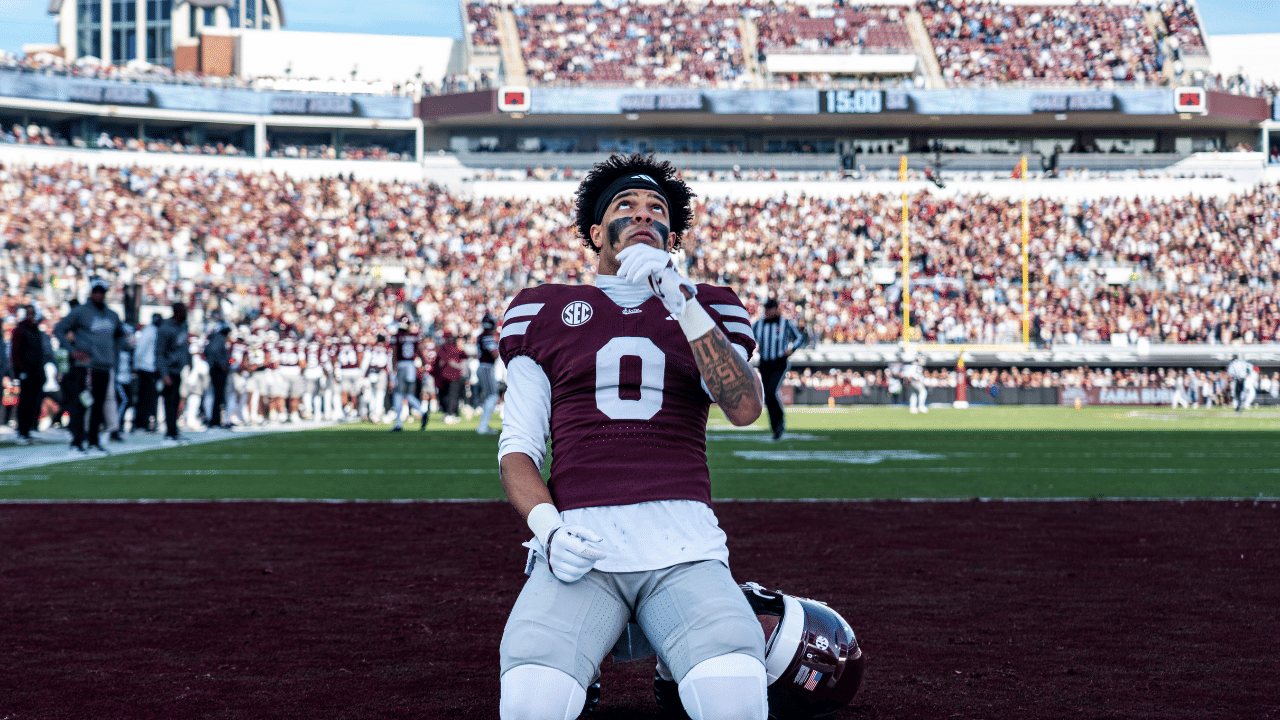
One name that continues to come up is Brenen Thompson, the speedy wide receiver who finished his college career at Mississippi State. Thompson has long been known for elite speed, but the buzz around him has grown during the pre-combine process.
Reports from training sessions have suggested he has been posting extremely fast times, fast enough that many evaluators believe he has the best chance in this draft class to at least threaten Worthy’s mark when receivers take the field.
Speed has always been the foundation of Thompson’s game. Originally a four-star recruit from Texas, he built his reputation not just on the football field but on the track as well. Thompson was a standout sprinter in high school, winning events in the 200 meters and running a 10.39 in the 100 meters. That kind of athletic profile naturally translated to football and quickly made him one of the most dangerous vertical threats on any roster he joined.
His college path moved around a bit before landing in Starkville. Thompson began his career at Texas before transferring to Oklahoma, where he spent two seasons developing his game. He eventually followed his offensive coordinator to Mississippi State when that coach took the head job, finishing his career with the Bulldogs while continuing to showcase the speed that made him such an intriguing prospect in the first place.
While the raw speed stands out immediately, Thompson is more than just a straight-line athlete. He tracks deep passes extremely well and looks comfortable catching the ball over his shoulder at full speed, almost like a center fielder running down a fly ball. That ability showed up in the numbers during the 2025 season, when he ranked second in the nation in average depth of target at 18.4 yards. Quarterbacks consistently trusted him to stretch the field and make plays downfield.
His route running also helps create those opportunities. Thompson does a good job selling the vertical route with his acceleration, forcing defensive backs to respect the serious threat before he snaps off his breaks. His ability to decelerate quickly and change direction allows him to generate separation even when defenders are prepared for his speed.
Despite having a smaller frame than most outside receivers, Thompson spent much of his time lined up on the perimeter rather than in the slot. His quickness off the line and ability to vary tempo help him slip past press coverage more often than expected. He also brings a surprisingly scrappy attitude to the field, showing real effort as a run blocker and competing hard in every phase of the game.
Of course, his size remains the biggest concern as he transitions toward the NFL. Thompson does not win many contested catches and can struggle with positioning when defenders crowd him at the catch point. That limitation will likely affect how teams envision using him at the next level. Learning how players such as Tyler Lockett have extended their careers by avoiding unnecessary punishment and maximizing efficiency could be valuable for Thompson as he adapts to the league.
Even with those concerns, his explosiveness makes him an intriguing prospect. Teams looking for a vertical threat or a player who can stress defenses with pure speed may see significant upside. Others may view him as more of a specialized weapon who needs the right offensive coordinator to fully unlock his skill set.
At the moment, Thompson projects as a mid-round selection with a solid but not elite draft grade. Evaluations place him around the twelfth among wide receivers in the class, with a projection in the third round. Still, that outlook could change quickly depending on what happens at the combine.