


Denny Hamlin Absolves NASCAR and Goodyear, Blames the Teams for Tire Issues

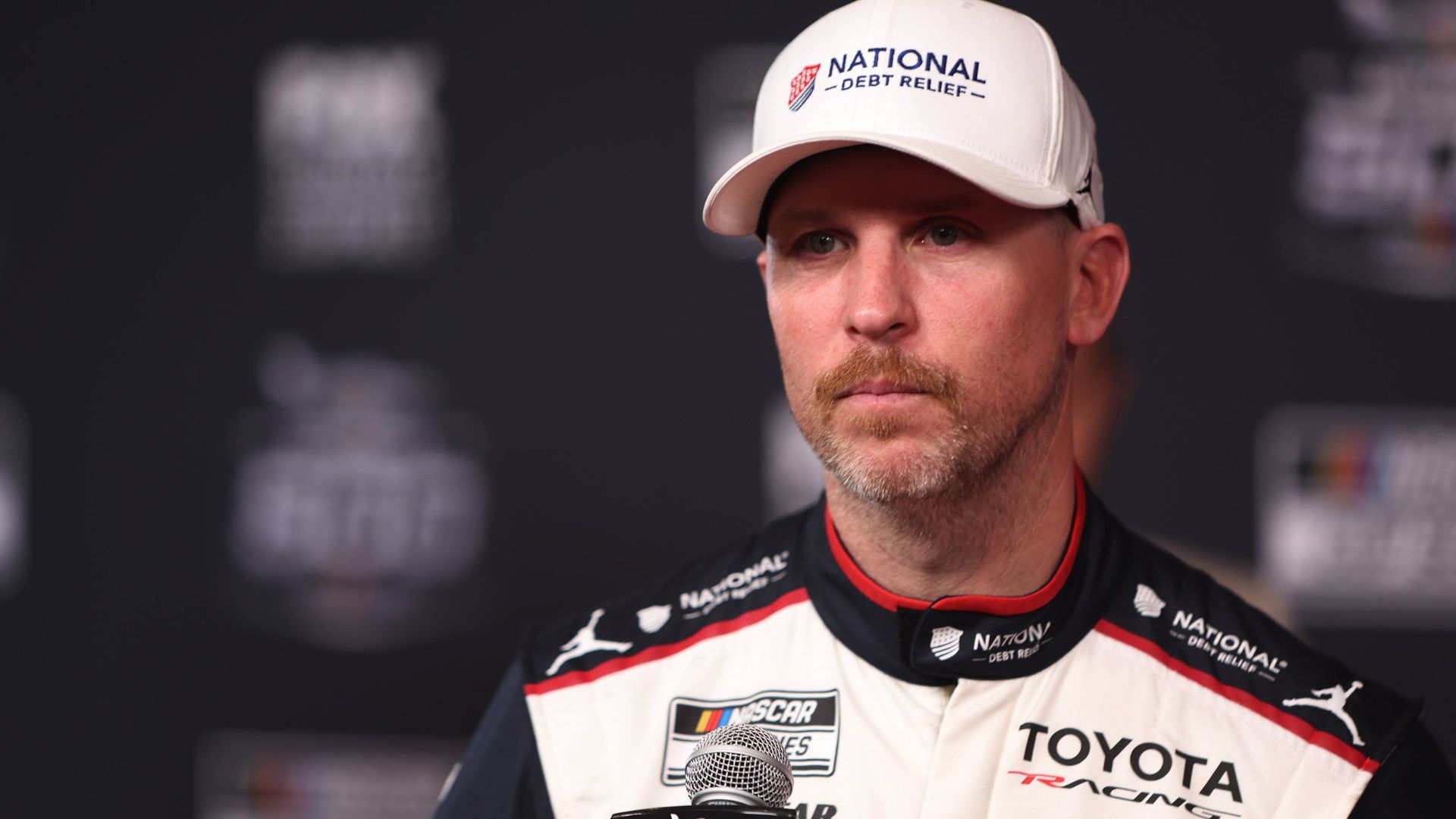
The 2026 Straight Talk Wireless 500 at Phoenix saw a high number of tire failures in the second stage of the race on Sunday. It raised serious concerns about Goodyear’s products and the sport’s overall quality control. However, Denny Hamlin believes the failures were not due to a quality issue. Instead, he blamed the teams.
There is a recommended level of tire pressure that cars need to maintain during a race. For Phoenix, it was 14 PSI in the left front, 30 PSI in the right front, 14 PSI in the left rear, and 26 PSI in the right rear. Teams generally opt to maintain a lower pressure than the recommended PSI, particularly on the right side, to gain a speed advantage.
The lower the pressure on the right side, the better the mechanical grip and downforce, you see. But the risk of tire failure increases in proportion, too.
“It’s the teams. We’re just pushing it. We certainly know that the lower the air pressure, the faster you’re going to be in the long run. These teams just keep pushing it. So what they do is they get somewhat comfortable in practice,” Hamlin said.
“They run the first run of the race, see where things are. Then all of a sudden they’re like, “All right, well, let me take another tenth or two out of the tire,” the Joe Gibbs Racing driver added.
Hamlin‘s explanation explains why there weren’t any tire issues in the first stage. There were a total of 12 cautions during the race. There was an instance when multiple cars pitted during a single caution due to issues with their tires. But then, if Hamlin is right, teams can’t blame anyone else for it.
Teams need to be calculative about how much pressure they choose to reduce in each tire. Going far below the numbers recommended by Goodyear could put safety at risk.
Having spent time on the pit box, former driver and crew chief Steve Letarte understands why teams want to run lower air pressure. He, like Hamlin, absolved Goodyear of any blame for the Phoenix failures.
“Less air is better,” said Letarte. “Less air is better for mechanical grip. Less air is better to get your diffuser to the ground to create more ground force. Less right rear air is better.”
Since teams would always be inclined to push the envelope of tire pressure to gain some edge on the track, Letarte felt NASCAR should reconsider the number of tire sets allowed during a race. The current limit is eight sets. Letarte believes that the number should be increased to 10.
About the author

-
Gowtham Ramalingam •
“We Don’t Have Any Other Knowledge”: Chase Elliott Insider Predicts How NASCAR’s Clash at Bowman Gray Will Play Out
-
Gowtham Ramalingam •
2025 Chili Bowl Nationals: Debutants Kyle Busch & Ty Gibbs Among Other NASCAR Drivers on Ever Growing Entry List
-
Neha Dwivedi •
“Trying to Sell Myself to Have Partners”: Chandler Smith Paints Grim Reality of NASCAR Drivers Amid Contract Uncertainty
-
Gowtham Ramalingam •
Austin Cindric Reveals Why He Prefers to Not Keep in Touch With Other NASCAR Drivers: “The Only Relationship That Exists”
-

Jerry Bonkowski •
NASCAR Insider Compares Kyle Larson to Deion Sanders Amid Approaching Indy-Charlotte Double
-
Jerry Bonkowski •
“It Was on Me”: Christopher Bell Directs Blame Away From Car Pace After P2 Finish in Mexico