


Why Is Pocono Raceway Known as ‘The Tricky Triangle’? Exploring One of NASCAR’s Most Unique Venues

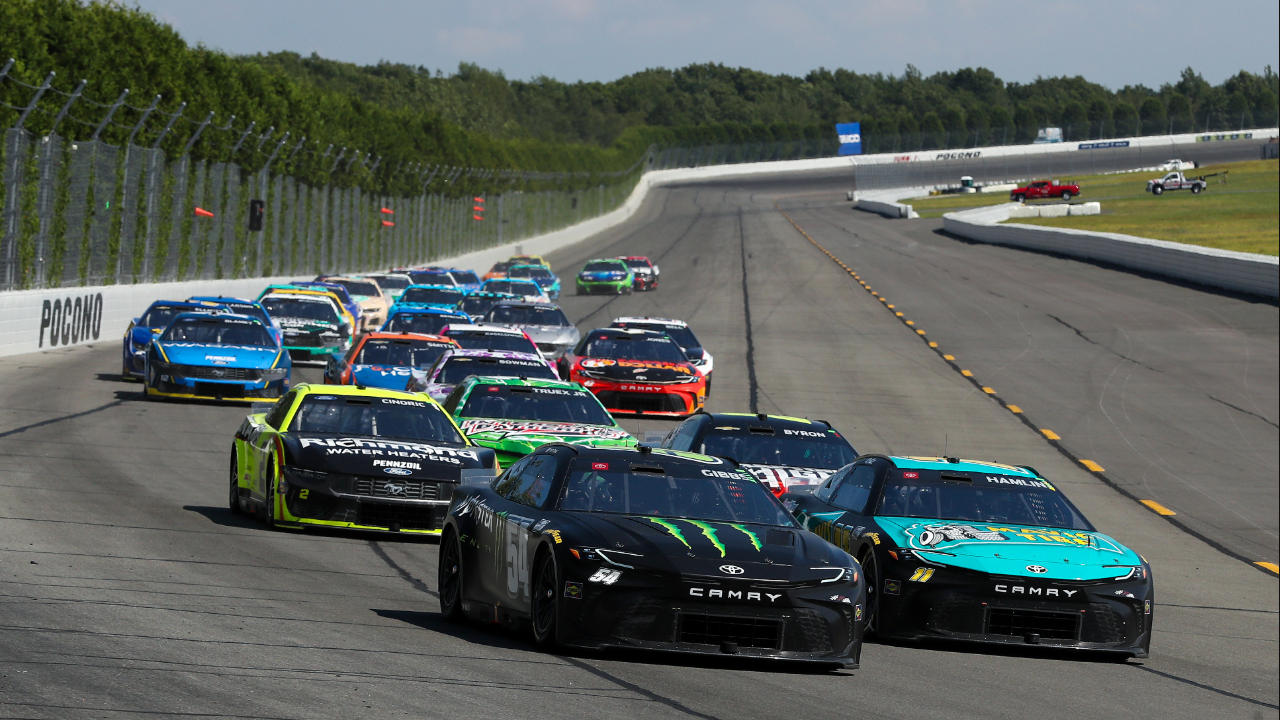
While the 2023 Pocono race stirred the pot with Denny Hamlin edging out Kyle Larson in a win that sparked a lasting rivalry, the 2024 sequel at the track was free from such drama. Instead, it featured Ryan Blaney revisiting the site of his maiden NASCAR Cup Series victory and once again taking the checkered flag — this time holding off Hamlin, the track’s most decorated competitor, by 1.312 seconds for his second win there.
The nickname ‘Tricky Triangle’ might sound like a catchy marketing phrase, yet it’s anchored in reality rather than mere hype. Unique in the NASCAR circuit, no other track mimics its distinct design or the strategic challenges it poses.
The ‘Triangle’ descriptor reflects the track’s unusual scalene triangle configuration, while ‘tricky’ aptly captures the complex tactical demands it places on crew chiefs and their drivers.
The raceway is distinctively shaped with three unequal sides and corners, lacking a fourth turn — hence their tagline, “What turn 4?”
The 2.5-mile track features three unique corners: Turn 1, banked at 14 degrees, mirrors Trenton Speedway; Turn 2, also known as the Tunnel Turn with an 8-degree bank, draws inspiration from the iconic Indianapolis Motor Speedway; and Turn 3, with a gentle 6-degree bank, echoes the Milwaukee Mile.
The layout, combined with its relatively flat terrain, adds a unique strategic element to the races held here.
Designed by Rodger Ward, a celebrated two-time Indianapolis 500 champion, the track’s architecture borrows elements from three venerable racing venues, creating a challenging circuit that tests the mettle of NASCAR’s best.
But that’s not it. The Pocono Raceway, distinguished by its trio of uniquely challenging turns also features straightaways of different lengths. It has one of the longest straightaways in NASCAR, stretching 3,740 feet along the front stretch. It’s complemented by a 3,055-foot “back” straightaway and a 1,780-foot short chute.
That’s why the configuration presents a conundrum for drivers and their crews: achieving optimal speed on these lengthy stretches while ensuring the cars can adeptly navigate the varied turns — each one distinct in its design.
The track’s complexity has been a proving ground for NASCAR’s elite since its debut in 1974. Jeff Gordon, with six victories, and Hamlin, with seven, have demonstrated particular prowess here.
Additionally, Pocono has been the backdrop for pivotal first wins, marking career milestones for drivers like RFK Racing’s Chris Buescher and Ryan Blaney.
About the author


-
Neha Dwivedi •
Tyler Reddick “Was in Another Category”, Rues Brad Keselowski After P2 Finish at Darlington
-
Neha Dwivedi •
NASCAR Martinsville Prize Money: How Much Will the Drivers Make During the Cook Out 400 This Sunday?
-
Gowtham Ramalingam •
Dale Earnhardt Jr. Backs Connor Zilisch as NASCAR’s Next Mainstream Breakout Star
-

Gowtham Ramalingam •
Chevrolet’s 2026 NASCAR Body Might Have ‘Thrown Them for a Loop’ According to Kevin Harvick
-

Neha Dwivedi •
Denny Hamlin Isn’t Convinced NASCAR’s New Darlington Aero Package Can Fix ‘Track Position’ Racing
-

Gowtham Ramalingam •
“Read Between the Lines”: Darrell Waltrip’s Darlington Appearance Has Fans Talking About His Take on Modern Day NASCAR