
In the moments before Greg Biffle’s crash, a chilling message was sent from aboard the plane that portrayed the gravity of the situation. Biffle’s mother-in-law, Cathy Grossu, has revealed that the former NASCAR driver’s wife, Cristina, texted her that they were in trouble just minutes before impact.
Advertisement
Cristina’s text offered no details about what had gone wrong. And federal authorities are conducting an investigation, and several possible factors have since emerged.
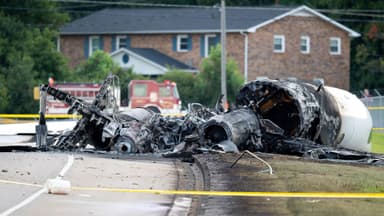
Preliminary reports indicate that Biffle’s aircraft struck the approach lights approximately 1,800 feet short of the runway before skidding across the infield after catching fire. Aviation podcaster Max Trescott, meanwhile, highlighted an anomaly in the ADS-B flight data that may point to an altimeter malfunction prior to the aircraft turning back.
According to Trescott, the data showed not a routine fluctuation but a sudden spike. In a span of just 1.64 seconds, the aircraft appeared to climb 1,374 feet. That immediately raised red flags.
“I discovered that it was more than a jump in altitude. It was a spike in the data. The ADS-B data shows that in 1.64 seconds, the aircraft climbed 1,374 feet,” he said on the podcast.
Trescott added that the altitude had remained unchanged for the 34 seconds leading up to that spike, strengthening the suspicion that something was amiss with the altimeter. While he emphasized that such an issue likely did not directly cause the crash, he also acknowledged that its role in triggering subsequent events has not been highlighted.
For now, both the National Transportation Safety Board and the Federal Aviation Administration continue to examine the sequence of events that led to Biffle’s plane crash.
Another theory has surfaced from within the racing community. NASCAR veteran Kenny Wallace suggested that an engine failure may have set the chain reaction in motion. In Wallace’s view, the aircraft may have lost a motor and begun to experience significant drag.
Although planes can typically remain airborne on a single engine, Wallace speculated that with the flaps deployed, horsepower would have reduced, drag increased, and the aircraft simply could not stretch the glide far enough to reach the runway.
At this stage, officials have not released a definitive cause. Until the investigation reaches its conclusion, speculation will come out among fans and insiders, each theory reflecting an attempt to make sense of a devastating loss.
Biffle died in the crash alongside his wife, Cristina, daughter Emma, son Ryder, and three others. The aircraft went down at Statesville Regional Airport, north of Charlotte, North Carolina, on December 18, 2025.
The tragedy also reopened a painful portion in the sport’s history. Aviation-related deaths have long impacted NASCAR, with airplane and helicopter crashes claiming the lives of several notable figures over the decades. Biffle’s passing now joins that somber list. It seems over the years, the danger has followed the sport not only on the track, but in the skies as well.