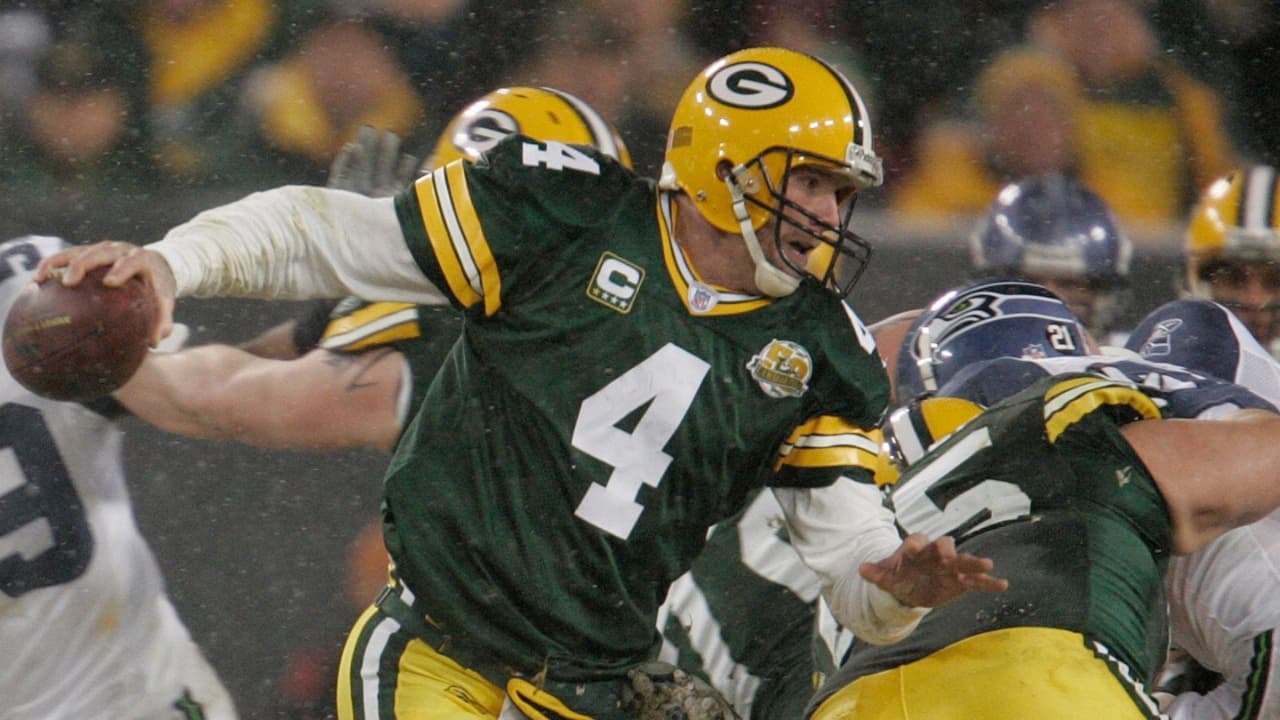
Arguably the most impressive thing Brett Favre accomplished during his illustrious two-decade NFL career was his Iron Man streak. Favre didn’t miss a single start from 1992, his second year in the NFL, until 2010, his final year in the league. That streak of 297 straight starts (321 if you include the playoffs) is one of the untouchable records in NFL lore.
Advertisement
But the fact that he was able to accomplish such a run was even more surprising if you watched him play. Favre was not exactly a pocket passer. He ran around and took big hits all the time. So how did he manage to stay fit so consistently for nearly two decades?
According to Favre himself, a big reason he was able to stay on the field was his size. At 6’2″ (though he calls himself 6’3″), Favre was “middle of the pack” in terms of height when compared to other QBs. But at 245 pounds and up past 250 during his prime years, Favre was certainly one of the heaviest QBs in the NFL in the 1990s. And that weight did not come from fast food. It came from the weight room.
“I was 245 [pounds] when I was drafted, and I played the first Super Bowl at 253,” Favre revealed (via 4th & Favre).
“The second Super Bowl, the following year, I was about 245. And I was a heavy lifter back then… and you don’t have to lift a lot to be a quarterback. I think that was part of my reason for escaping injury… was physically, I kept myself in as good a shape from a weight room perspective. I was kind of a weight room guy,” added the Super Bowl-winning QB.
That extra protection and poundage he gained from his dedication to pushing steel likely helped him stay as healthy as he did. Favre also compared his size to that of some of his idols from the 1980s and early 1990s: Jim Kelly, Dan Marino, and John Elway.
“I was always like Jim Kelly, I’m thinking back to my early days, Jim was a big guy,” Favre said. “Dan Marino was a big guy, John Elway. All three of those guys were about my size, maybe a few pounds more, a few pounds less depending on the day.”
That said, while Favre was considered very big back then, he would barely be considered big by today’s QB standards.
Could there be a connection between healthy QBs and big QBs?
Franchise QBs these days are regularly 6’5″ and above. And more and more signal callers are bulking up even more than Brett Favre did to withstand the rigors of the game, which is dominated by hulking defensive ends on the other side.
“But now, it’s crazy. You’ve got 6’6″, 260. You don’t see [5’9″] Doug Fluties running around,” Favre joked, before adding, “The athlete in general, not just at the quarterback position—I wonder, when does it stop? You’ve got defensive ends that are 6’6″, 275 that run 4.7 40s, maybe even faster. You better be able to move if you’re a quarterback … dodge and weave some.”
There is something to be said about those bigger QBs being able to stay healthy despite their more physical style of play. Favre, who was listed at a playing weight of 222 pounds later in his career, had his streak.
Marino, who was 6’4″ and 224 pounds, missed just 20 of 240 games from 1984-1998. Kelly was 6’3″ and 217 pounds and missed just 16 games across an 11-year career. Elway, checking in at 6’3″ and 215 pounds, missed just 22 games of a possible 256.
Buffalo Bills QB Josh Allen, who Favre sees as the “poster child” for big, thick QBs these days, has played in 122 straight games going back to the end of his rookie year. He stands 6’5″ and weighs 237 pounds. There’s no telling if there’s causation going on here, but there’s certainly correlation between big QBs and an ability to stay on the field.