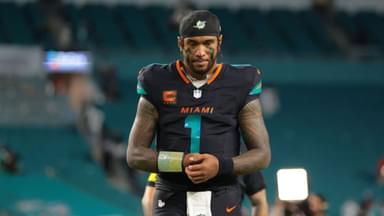
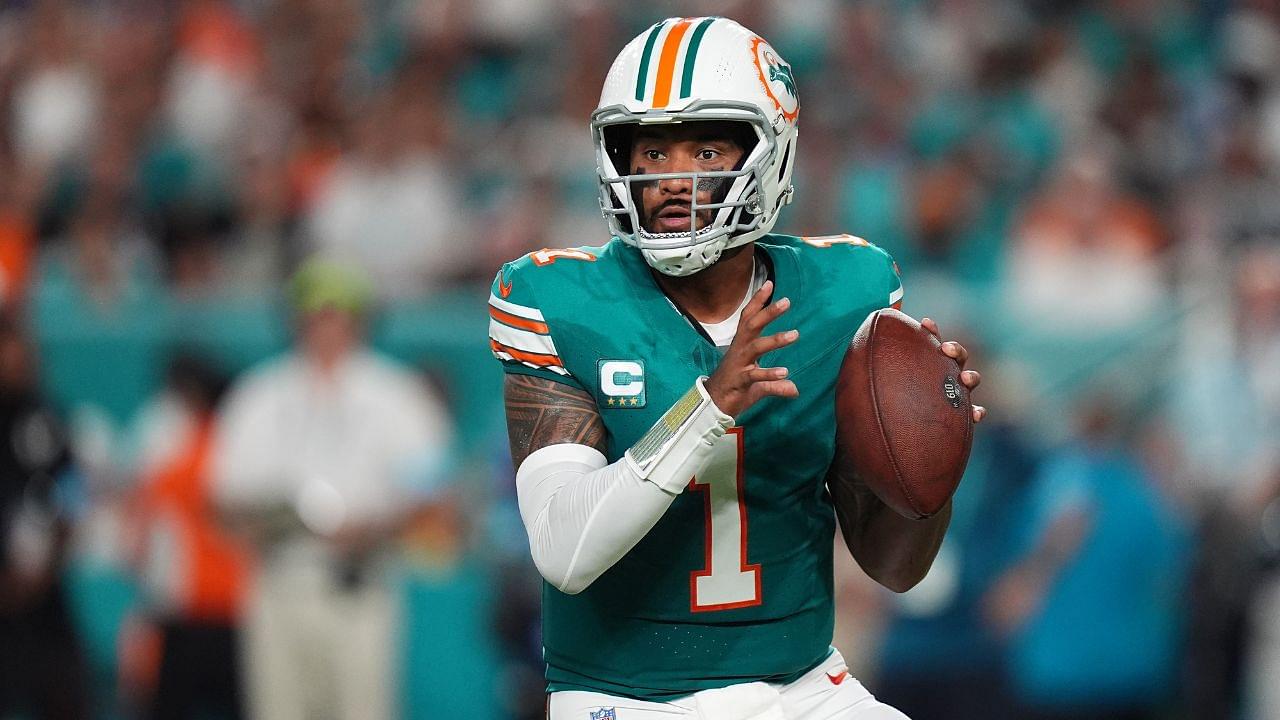
The Miami Dolphins have officially benched quarterback Tua Tagovailoa, turning the offense over to rookie Quinn Ewers for Sunday’s matchup against the Cincinnati Bengals. Head coach Mike McDaniel announced the decision Wednesday, stressing the need for what he repeatedly called “convicted quarterback play.”
Advertisement
The move comes after Miami’s 28–15 loss to the Pittsburgh Steelers on Monday night, a defeat that eliminated the Dolphins from playoff contention. Tagovailoa completed just 6 of 10 passes for 65 yards and an interception through three quarters before being replaced late in the game by Ewers, who went 5-of-8 for 53 yards.
Tagovailoa’s struggles have extended well beyond one game. Through 14 contests, he leads the NFL with a career-high 15 interceptions. He hasn’t thrown for more than 173 yards in a game since Week 9, and McDaniel has openly acknowledged for weeks that Miami’s passing offense has not been good enough.
The former first-round pick admitted he was “disappointed” by the benching and “not happy about it,” but said it forced him to take an honest look at his performance. When asked if he believes he has played his final game in a Dolphins uniform, Tagovailoa said, “I can’t predict the future.”
Former Raiders CEO Amy Trask addressed Tagovailoa’s uncertain future during a recent appearance, pointing to Baker Mayfield as an example of how a quarterback’s career can be revived after an unceremonious exit.
“A quarterback needs a lot of things to work for him,” Trask said. “It can just be a change of scenery. There are players who move from spot to spot that achieve down the road with a new team what they didn’t achieve in the past.”
Trask emphasized that growth often comes from adversity and better alignment between player and system.
“Sometimes it’s just learning from the problems you had in past situations. The best coaches best position their players to be their best,” she said. “Baker was not treated properly in Cleveland. He played tremendously injured. He’s now somewhere where he is performing better.”
The comparison is notable. Like Mayfield, Tagovailoa is young, has shown high-end production, and now finds himself at a crossroads after a franchise seemingly lost faith.
What makes Miami’s situation uniquely complicated is the money. Tagovailoa signed a four-year, $212.1 million extension in 2024 after leading the NFL with 4,624 passing yards in 2023 and guiding the Dolphins to 11 wins and a playoff berth.
That investment now looks increasingly problematic.
Tagovailoa is due $54 million guaranteed next season. Trading him before March 13 would result in a $45.2 million dead cap hit. A trade after that date balloons the dead cap charge to $60.2 million. Releasing him outright before then would saddle Miami with $99.2 million in dead money — the largest cap hit in NFL history.
A post-June 1 designation would allow the Dolphins to split the damage, with $67.4 million hitting the 2026 cap and $31.8 million in 2027. Even then, it’s a massive financial wound.
What Are the Dolphins’ Real Options?
Miami essentially has four paths:
Keep Tagovailoa – potentially as a backup, similar to what Atlanta did with Kirk Cousins. This avoids historic dead money but creates an awkward locker-room dynamic with a $50-plus-million reserve quarterback.
Trade Him – difficult but not impossible if Miami attaches draft picks and finds a team with cap space willing to gamble on upside.
Release Him – the cleanest football solution, but financially brutal, even with a post-June 1 designation.
Get Creative – restructuring, timing a release, or engineering a quarterback swap to minimize damage.
The Broncos showed last season that a team can survive a massive dead-cap hit after releasing Russell Wilson, rebound quickly, and even become a contender. That precedent matters.