


Backup Cars in NASCAR: How Do Teams and Drivers Use Backup Cars in the Race?

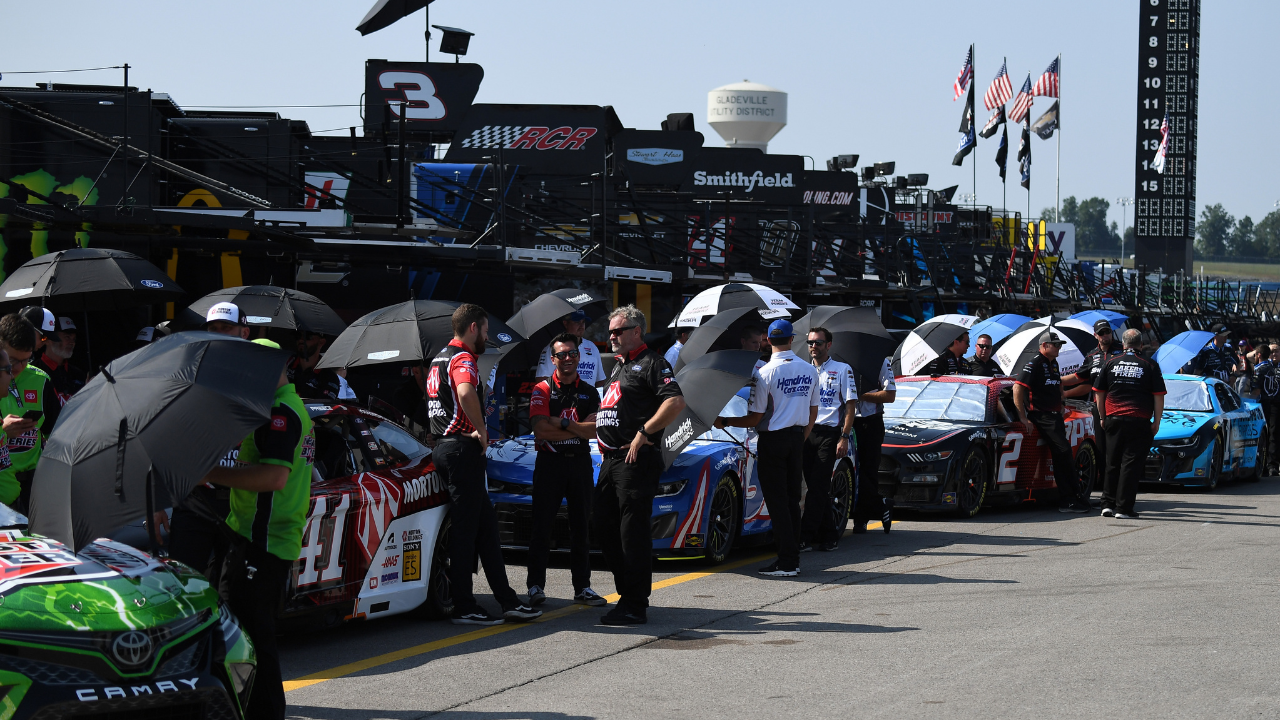
In the competitive arena of NASCAR, where about 40 cars cruise at high speeds battling it out three or at times even four wide, the chances of contact are extremely high. However, these cars are the biggest assets of every race team out there. So needless to say, the teams need to be prepared for any mishap on the racetrack. And that’s where the backup cars come in.
Typically, every team has one backup car, which undergoes prior inspection to check if they tick all the boxes under NASCAR’s safety standards. But not every team can afford a backup car. Moreover, one has to start from the back of the field if they switch to a backup car (meaning losing track position), and that too, can’t be done in the middle of a lap. And with master builders and talented engineers in the garages, why would the teams even resort to an entirely new car?
This is because backup cars are used in the worst-case scenarios. There are times when the primary cars get wrecked so badly that they are beyond fixing. The drivers then have no better option than to buckle themselves up to the backup car, which again, they need to acclimatize with.
Now, some might wonder what happens when you wreck the backup cars. In a Joe Gibbs Racing video, this scenario was explained as well. They said, “In the race, whether the backup car or the primary cars crash, doesn’t matter. If you crash in the race, your day is done Since you can’t continue practice with the backup car, it’s pretty much impossible for you to not have a car to start the race with.”
Does NASCAR allow a backup driver?
In a scenario in which a driver gets badly injured and is unable to drive any further, NASCAR has a substitute driver rule that allows a substitute driver to replace the original driver if the latter is unable to continue due to any reason. One such instance took place back in 2013 when Tony Stewart was injured in a sprint car crash and his ride at Watkins Glen was taken over by Max Papis.
That ride was later substituted by Austin Dillon and eventually by the legendary Mark Martin.
The rule is also applicable if a driver needs to stay away from the race due to personal reasons. Last year when RFK Racing’s owner Brad Keselowski’s wife Paige went into labor, the #6 driver had to step away from work and be by his wife’s side. In Keselowski’s place, Cole Custer was chosen as the substitute driver for Keselowski’s #6 Mustang.
About the author


-

Neha Dwivedi •
Meet Ross Chastain’s New Girlfriend Jordyn Mallory — A Country Music Twist After His Erika Anne Turner Era
-
Srijan Mandal •
What Is Dale Earnhardt Jr.’s Dream Race Car?
-

Neha Dwivedi •
“Biggest Compliment People Have Given Me”: When Christopher Bell Felt Honored for Kyle Larson Comparisons Before NASCAR Stardom
-
Neha Dwivedi •
Chase Briscoe Disagrees With Chase Elliott on Controversial Darlington Take: “It’s Something That I Love”
-
Srijan Mandal •
“I Hate This for Our Fans”: Chase Elliott’s Dishonest Response to Kyle Larson Question Called Out by Insider
-
Gowtham Ramalingam •
‘Will Always Respect our Hardcore Fan’: NASCAR Insider Insists Recent Expansion Plans Necessary for the Sport