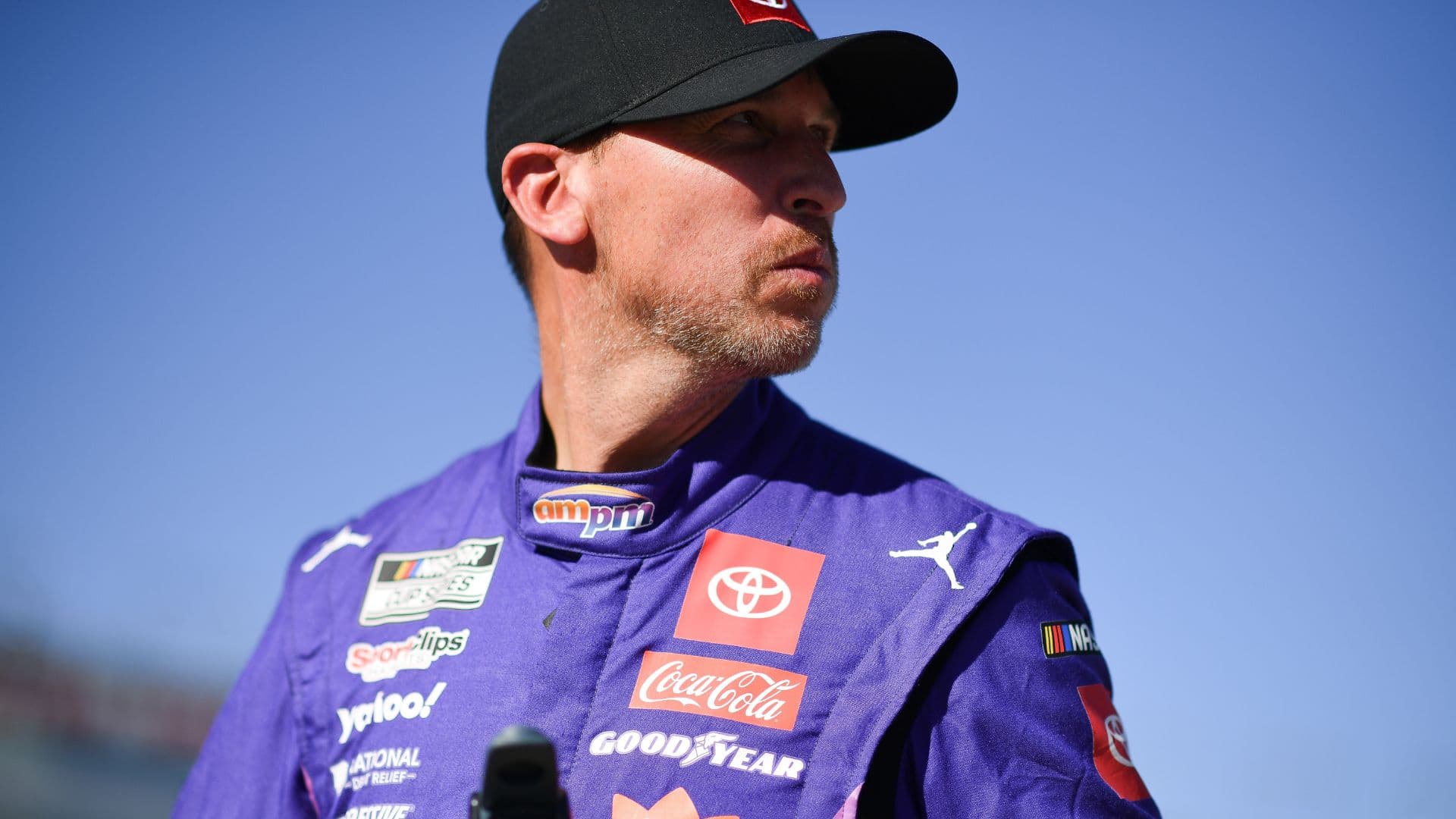
A few months back, Denny Hamlin spoke about how NASCAR’s move to fully standardize parts from the 2022 season has led to growing frustrations in the pit lane. While the shift was intended to control costs, its ripple effects have created more issues.
Advertisement
Competitive balance has tightened to the point where cars now mirror one another almost perfectly, leaving drivers with fewer tools to create separation on track. Passing has become more difficult, short-track racing has lost much of its edge, and teams have found themselves boxed into purchasing expensive components from approved suppliers, even when those parts fail to suit their setups or when alternatives elsewhere in the market might outperform them.
Hamlin explained that once NASCAR signs a category partner, teams lose their entire freedom within that space. If the sanctioning body locks in a fuel or tire partner, teams cannot seek sponsorship from a competing brand in the same category. That restriction applies regardless of competitive benefit or financial upside. According to the Joe Gibbs Racing driver, the most critical performance elements on a race car, fuel and tires, sit squarely within those locked categories, yet teams remain unable to leverage them commercially.
Hamlin expanded on that point with a concrete example, saying, “I think we probably pay about $700,000 a year in tires. In tires. I mean, Goodyear is the official provider of NASCAR tires, but we have to purchase them. They’re not given to us. We have to purchase them. “But that’s an agreement that they have with NASCAR itself. And again, it’s a category where we couldn’t go get a Michelin to sponsor our car.” The structure has contributed to broader consequences across the garage.
Mechanical innovation has slowed as teams operate within the limits of a spec car. Distinct driving styles carry less influence when equipment behaves the same across the field. At the same time, safety and performance concerns tied to mandated components often leave teams powerless to act independently. NASCAR’s requirement that teams purchase parts exclusively from approved vendors has shifted problem-solving authority away from the organizations that race the cars weekly. Manufacturers have felt the effects as well.
Chevrolet, Ford, and Toyota now have limited room to highlight engineering identity or technical evolution. With fewer avenues to differentiate, their ability to connect innovation to on-track performance has diminished, a factor that could affect long-term investment and fan engagement. When flaws emerge in a required component, the impact becomes universal. Every team must wait for NASCAR and its supplier to address the issue.
The early version of the Next Gen chassis highlighted that risk. Its excessive stiffness failed to absorb impact energy effectively, contributing to a series of injuries and concussions before adjustments were made. Tires present another constraint. With Goodyear serving as the sole supplier, teams cannot explore alternative compounds or manufacturers to better match track characteristics or driving approaches. That strategy exists in other forms of motorsport.
Formula 1, while also operating under a single-supplier model with Pirelli, still allows teams to select from multiple compounds. NASCAR’s low-profile Next Gen tires have further altered feedback, reducing the tactile “feel” drivers rely on to manage grip and balance. Although standardization was intended to reduce costs, several teams argue that the economics remain unfavorable. The mandated parts come with high purchase prices, yet teams do not retain ownership, as the components remain NASCAR property.
That imbalance has fueled recent antitrust litigation, prompting teams to question the model’s sustainability. Now, with NASCAR signaling openness to restoring limited innovation and increasing horsepower, optimism has begun to surface. If implemented, those changes could reintroduce speed, improve race quality, and give teams greater control starting next season.