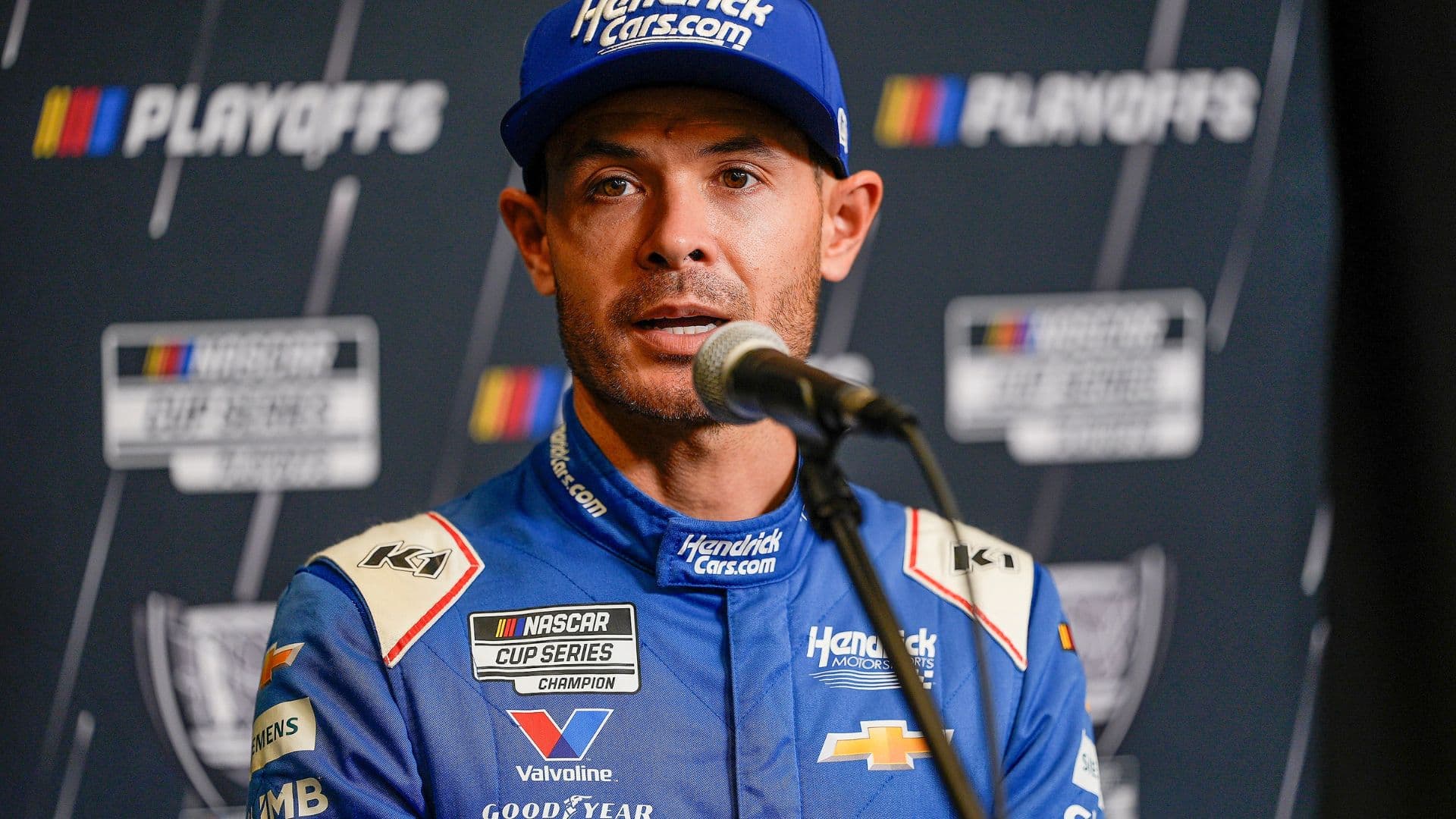
Three out of Kyle Larson’s 32 wins in the NASCAR Cup Series have come at Bristol Motor Speedway. And those were dominant victories. In his last three outings on the track, he has reached Victory Lane twice, and across 19 starts, he has finished eight races inside the top five and 13 within the top ten.
Advertisement
Short track racing’s allure has diminished in the Next Gen era. When drivers like Larson command 411 of 500 laps or 462 of 500 laps, it becomes a bit boring for spectators. Also, the Next Gen car’s parity means there isn’t sufficient momentum for overtaking on compact circuits such as Bristol.
The moment drivers accelerate to gather speed, a left-hand turn comes up, forcing them to brake aggressively to avoid wrecking themselves or colliding with the wall while managing the aerodynamic force. But the scenario has overwhelmingly worked in Larson’s favor. And he points to his dirt racing pedigree as the reason for the success.
In his last 13 starts at Bristol Motor Speedway, Larson has never qualified below the top ten, barring two occasions (in 2023 and 2019). The combination of track characteristics and Next Gen machinery has played into his hands.
“Bristol would be my favorite. Just half a mile, small track, high banking, really fast-paced the whole time, just really intense. It’s a lot of fun,” said Larson, before talking about the catalyst behind this dominance on the Out of Bounds podcast.
“I think that’s why [background in dirt racing] I enjoy it, and I adapted to it well, just because it’s the most similar to dirt racing to me than any other track we go to, just that intensity and high pace,” he said.
Larson’s career in dirt racing, where surface contours keep changing lap by lap, enables him to anticipate how the Bristol surface will evolve. He manages to find traction where his competitors cannot.
Larson frequently employs a “diamond technique“ at Bristol. It’s a specialized racing line he routinely utilizes to overtake slower cars and generate momentum that allows him to negotiate a corner with a diamond-shaped trajectory rather than a traditional, consistent arc. He enters high and exits low, to preserve speed and execute passes, a skill he perfected while driving dirt sprint cars.
The high-banked, half-mile configuration of Bristol mirrors the sensation and intensity of a dirt sprint car contest that the Hendrick Motorsports driver has been a pro at. Split-second decision-making is necessary to navigate traffic on dirt as well as NASCAR short tracks.