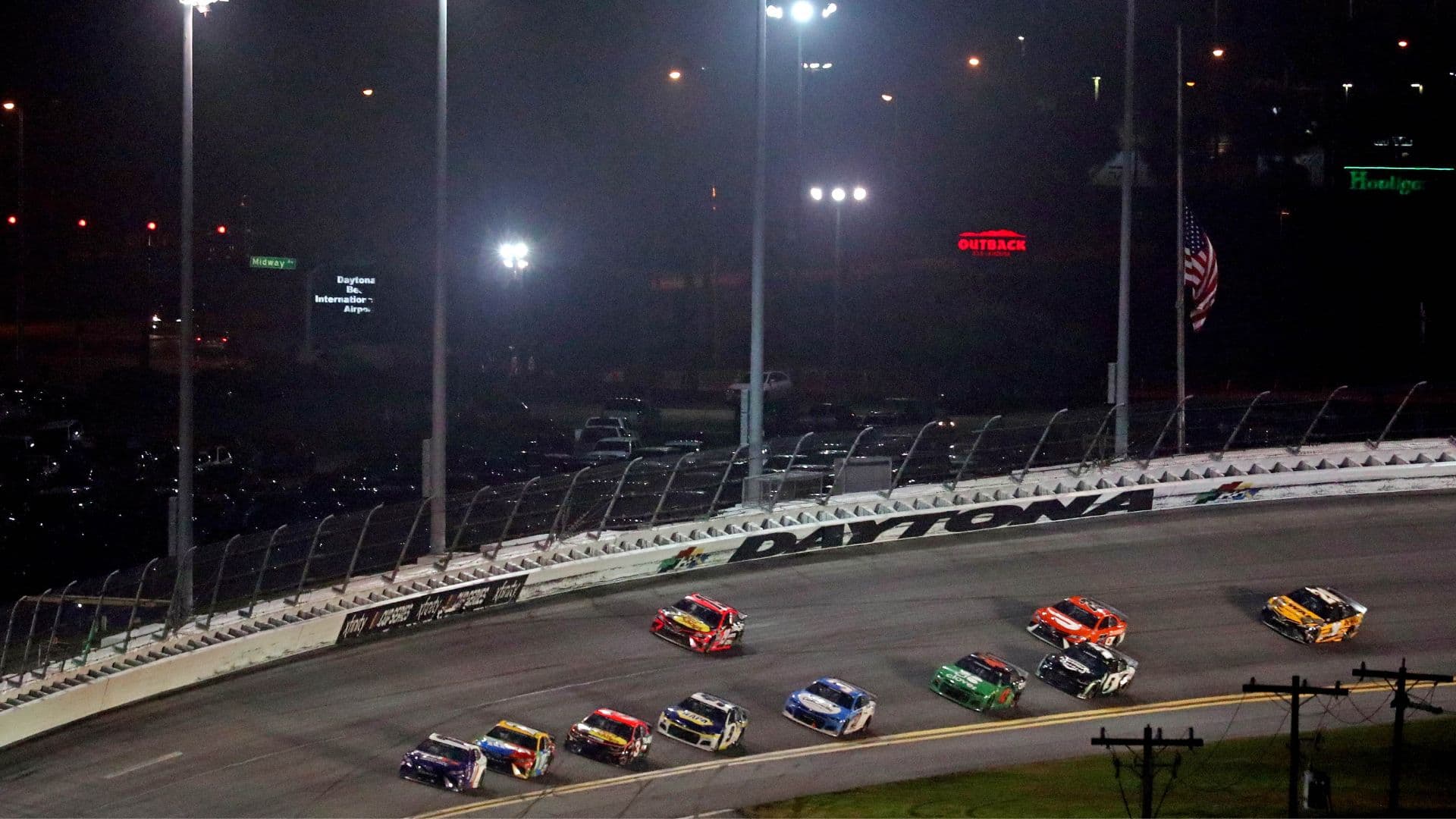
The Daytona 500 has stood as NASCAR’s biggest attraction since its early days, consistently commanding engagement unlike any other event on the calendar. Its pull has never relied solely on speed or spectacle. At times, circumstance itself has amplified the moment.
Advertisement
In 2012, when rain forced the race from Sunday to Monday and the green flag did not wave until after 7 p.m. ET, the delay only heightened anticipation. That edition went on to draw more than 36.5 million viewers, making it the most-watched Daytona 500 in history and eclipsing recent season finales by a staggering margin.
Veteran broadcaster Mike Joy, however, does not rank the 2012 race among his personal top five. His best races are as follows:
1998 Daytona 500
The 1998 Daytona 500 was a race carried by the collective longing of an entire sport. Dale Earnhardt Sr., despite years of dominance elsewhere, had never conquered Daytona’s biggest stage. Every fan understood the stakes, and that shared hope turned each lap into must-see television.
Joy believes the suspense peaked with two laps remaining, when uncertainty still hung in the balance. The moment also carried personal significance, as it marked Joy’s first Daytona 500 calling the action from the lead play-by-play position in the television booth.
2011 Daytona 500
Fourth on Joy’s list is the 2011 Daytona 500, a race remembered for its element of surprise. During practice, Jeff Gordon spent time drafting with Trevor Bayne, prompting Joy to ask why.
Gordon’s response was simple: Bayne’s car was fast. That speed translated into one of the sport’s most unexpected victories, as Bayne delivered a historic Daytona 500 win for Wood Brothers Racing, giving the organization a moment few saw coming.
2007 Daytona 500
Joy places the 2007 Daytona 500 third, citing its chaotic finish. Mark Martin, who had never won a 500 race before that, took the white flag in the lead, seemingly in control, before Kevin Harvick surged forward with help in the closing yards.
Harvick crossed the line first as the field wrecked behind him, a finish Joy considers among the wildest the race has ever produced.
1979 Daytona 500
The 1979 Daytona 500 also earns a place on the list, though its legacy extends far beyond the winner. Richard Petty claimed the victory, but history remembers the race for the final-lap clash between Cale Yarborough and Donnie Allison.
Joy, then stationed as the turn announcer in Turn 2, recalled struggling to process what he was witnessing in real time as the lead changed hands. He ultimately called Petty home ahead of Darrell Waltrip and A.J. Foyt after Yarborough and Allison crashed.
1976 Daytona 500
Yet the Daytona 500 that Joy says he can never forget dates back to 1976. That race distilled competition to its purest form, a two-car duel between Petty and David Pearson. When word spread that both cars had slammed into the wall in Turn 4, no one knew what would happen next.
Moments later, Pearson’s battered machine limped toward pit road and then crawled across the finish line. For Joy, it remains the ultimate example of two drivers refusing to yield.