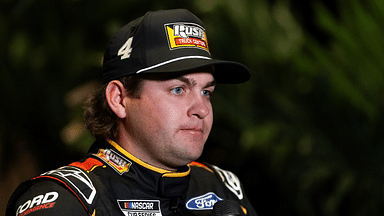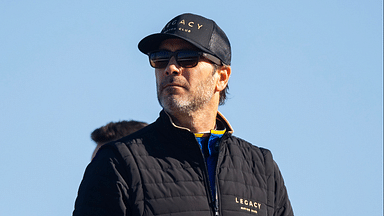

Jimmie Johnson and John Hunter Nemechek took a detour in their racing calendar last month, traveling to Japan for the USA Motorsports Culture Introduction Demo Run. The exhibition was staged alongside the final round of the 2025 Super Taikyu Series at Fuji Speedway on November 15 and 16.
Advertisement
Johnson and Nemechek’s visit drew widespread following, fueled largely by event’s success in capturing the Japanese fans. Johnson’s helmet gift to Toyota Chairman Akio Toyoda garnered attention as well. But, beyond the ceremonial moments and their own star power, it was the machinery they brought with them that stole the show.
A recent video released by Legacy Motor Club on its YouTube channel showed how different that machinery was. For the Japan showcase, the team constructed a one-off NASCAR Next Gen car designed specifically for a demo run. By reimagining what a NASCAR Next Gen car could be, Legacy Motor Club transformed an exhibition into a statement.
This was not the standard Cup car since the build required functional doors. That’s, of course, a feature NASCAR machines never carry. The changes went far deeper than cosmetic adjustments.
NASCAR Cup cars lack doors that open for a reason. They are engineered to absorb impacts at speeds approaching 180 miles per hour, prioritizing structural integrity over convenience. In Japan, however, the expectations were different.
Organizers wanted a passenger seat, something the Next Gen platform does not accommodate, as its interior is tailored solely around the driver. To meet that request, Legacy Motor Club had to rethink the car’s layout from the ground up. The solution required not only adding a second seat but also designing doors that could open and close safely.
John Burnell, a fabricator with Legacy Motor Club, detailed the project’s evolution in the video released by Legacy. He explained that the initial concept resembled a ride-along or exhibition car, closer to a display piece than a race-ready machine.
That changed once the request came in to turn it into a two-seater capable of running on track. The turning point arrived with an unexpected instruction.
“They said, the doors need to open. And I’m just like, the doors need to open? They’re like, Yes, we need to have doors open. And we prefer it to be like suicide doors, so open from the front, going back. I’m just like, ‘what?’ The most challenging thing about this project was definitely the doors,” narrated Burnell.
Making that happen required careful engineering. Burnell explained the process step by step.
“We basically cut out the doors of the saw. Cut out an opening, ordered a hinge set that was safe enough, and then put the correct door bars back in, just make some new ones, and then replayed and try to make a latching system to go along with it. That was also convenient to get in and out, but also safe at the same time,” he described.
The team modified the door pins, shaving them down slightly to create a buffer. That adjustment ensured the doors would not bind or lock when closed, balancing usability with safety.
The finished product exceeded the original brief. Legacy Motor Club delivered a functioning two-seater Next Gen car that met NASCAR’s structural standards while adhering to the unique demands of the Japanese event.
The payoff came when Akio Toyoda climbed into the car, riding alongside drivers including former Formula One driver Kamui Kobayashi. Toyoda also stepped into Nemechek’s Cup car before taking a turn in the Le Mans-spec Camaro ZL1 previously driven by seven-time Cup champion Johnson.