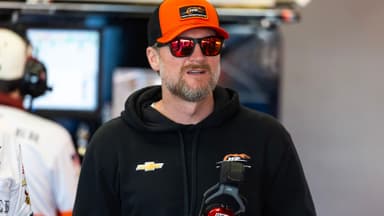
Although the antitrust dispute between NASCAR and its two plaintiff teams, 23XI Racing and Front Row Motorsports, has now been settled, one element of the case stood out to Dale Earnhardt Jr. What caught his attention most was the revelation that NASCAR officials felt threatened by Tony Stewart’s Superstar Racing Experience.
Advertisement
Dale Jr. addressed that point on a recent episode of The Dale Jr. Download, admitting his surprise at the disclosure. He said, “I gotta be honest, this shocked me.” Junior explained that when Ray Evernham first outlined the vision behind SRX, he believed the goal was to revive the spirit of the old IROC series.
In his understanding, SRX was designed to travel into local markets, feature retired drivers alongside distinctive personalities from various racing disciplines, and place a competitive car in the hands of a hometown favorite.
From Dale Jr.’s perspective, that original blueprint made sense. He viewed it as a creative concept, even if it never captured his personal interest. He acknowledged that he did not have the bandwidth to engage with the series early on, and made clear that he neither followed it closely nor invested much time watching it. Still, he was not opposed to its existence.
Dale Jr. said he dismissed the idea outright, noting how difficult it was to reconcile the scale of NASCAR with SRX’s footprint. To him, the notion that the sport’s top governing body would feel threatened by a much smaller operation seemed implausible.
He described SRX as a series running roughly a dozen cars while barely staying afloat financially. Junior pointed out that the series underestimated its operating costs and struggled to manage the damage incurred during racing.
Ultimately, the economics did not line up. SRX folded because it was expensive to run, television viewership failed to justify the contract, and the broadcast deal itself could not sustain the series. The financial model did not work.
However, when Kenny Wallace revisited the issue through the lens of testimony provided by Steve O’Donnell, it made more sense. According to O’Donnell, he investigated the matter and learned that former Stewart-Haas Racing executive Brett Frood had confirmed SRX’s original pitch.
That concept centered on retired and inactive drivers and did not position the series as a direct competitor to NASCAR.
The comparison to IROC gained traction when considering SRX’s early rosters. The series initially featured Tony Stewart, Tony Kanaan, Bobby Labonte, Helio Castroneves, Ernie Francis Jr., Paul Tracy, Bill Elliott, Willy T. Ribbs, Michael Waltrip, and Marco Andretti. That lineup reinforced the idea of a nostalgia-driven showcase rather than a rival championship.
The dynamic shifted, however, when active Cup Series drivers, including Chase Elliott, started showing interest in the same. His involvement opened the door for other recognizable names to follow.
That group eventually included Denny Hamlin, Justin Marks, Kyle Busch, Daniel Suarez, Kevin Harvick, Ryan Blaney, Chase Briscoe, Brad Keselowski, Austin Dillon, and Ryan Preece. Their presence elevated the series’ profile, helping SRX land a broadcast platform on ESPN. Ratings exceeded those of the Truck and Xfinity Series, a development that intensified NASCAR’s unease.
SRX continued to gain momentum, even on a limited scale. In that light, Dale Jr.’s dismissal of the series may have understated its potential influence. A growing platform that attracted active NASCAR drivers could have presented teams with an alternative direction if charter negotiations had stalled. That possibility, more than the series’ size, may explain why SRX drew NASCAR’s attention.