Tom Brady used to be about one thing and one thing only: winning football games. And throwing perfect spirals apparently. But mostly the first one.
Advertisement
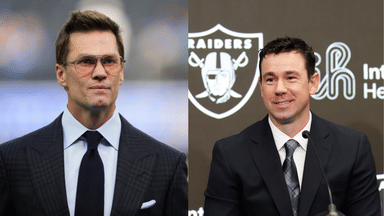
However, in his post-NFL career, Brady has a lot of different balls in the air. One of those is his position as a minority owner of the Las Vegas Raiders. He clearly played a bigger role in recruitment than most minority stake owners last season, and that’s likely to continue in 2026.
And while last year’s run of scouting didn’t go so well, Brady’s still new at this. And yet, TB12 already has a very well-thought-out system of evaluating player talent. He just might want to figure out a similar system for the coaching staff (nearly all of whom were fired after Vegas’ 3-14 campaign in 2025).
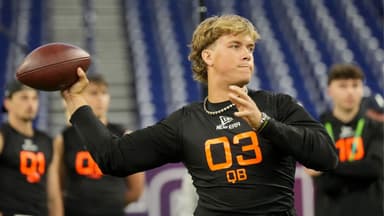
“You go into the NFL draft, and everyone’s like, ‘Look at this guy’s skill set. He’s really fast. He’s really big. Look how strong of an arm he has. Oh my god, he was on his knees, and he threw the ball 70 yards.’ But I’m like, ‘Okay, like, what does that mean?'” Brady questioned during his appearance on Spittin’ Chiclets.
“Is he mentally smart enough to take in information, process it, and use it on the field? Has he mastered the playbook? Does he know how to study? Does he know how to learn from his mistakes?” he added.
What Brady is saying is that there are many more components to a prospect than just the physical attributes. The mind is the most important thing, especially when you’re looking at a quarterback. To Brady, the player’s emotional intelligence is as important as anything.
“And then, emotionally, is he competitive every day?” Brady asked. “Is he really volatile as a leader? Does he know how to deal with adversity? Does he know how to deal with competition? How does he react when things don’t go his way? What’s gonna happen when he throws four interceptions in a game, how is he gonna respond to that? … When you play sports, adversity is coming.”
Brady went on to talk about his view on developing talent as well. As someone who played for nearly a quarter-century deep into his 40s, it’s no surprise that he’s from the “mental over physical” school of thought.
“My belief is you do get better as you get older. The people that are only focused on their physical ability, over time, you get worse,” Brady opined, adding,
“I learned to compete. I knew how to be resilient. I knew how to be competitive. I learned playbooks, I mastered playbooks, I trained hard. Because physically, I was actually way less developed than a lot of other guys, so I had to work my ass off to make up that ground.”
Brady then talked about how his hard work paid off dividends, even until he decided to hang up his cleats.
“Finally, when I made up that ground, I thought I was really well-rounded, and my ability to compete was at a much higher level… As I got better physically, through the course of my career, mentally and emotionally, I was awesome… At 25, I was good. At 35, I was great. At 45, I was a master of the sport.”
“At 25 I was good, at 35 I was great, at 45 I was a master of the sport”
–@TomBrady talking about developing the mental/emotional aspects of being a great quarterback compared to just the physical abilities on @spittinchiclets pic.twitter.com/fbTl5KK69J
— Viva La Stool (@VivaLaStool) January 13, 2026
It may be accurate for Brady, but most players are on the downturn when they hit 35, not hitting their professional prime. Brady may need to readjust his expectations when evaluating talent as he realizes one crucial fact: he is not going to find another Tom Brady in the draft.
Though this Fernando Mendoza guy they’re going to take No. 1 overall seems like he might come close.