


“He’s Not a Politician”: Michael Jordan Never Spoke on Politics to Protect His Brand Image, Says Scottie Pippen

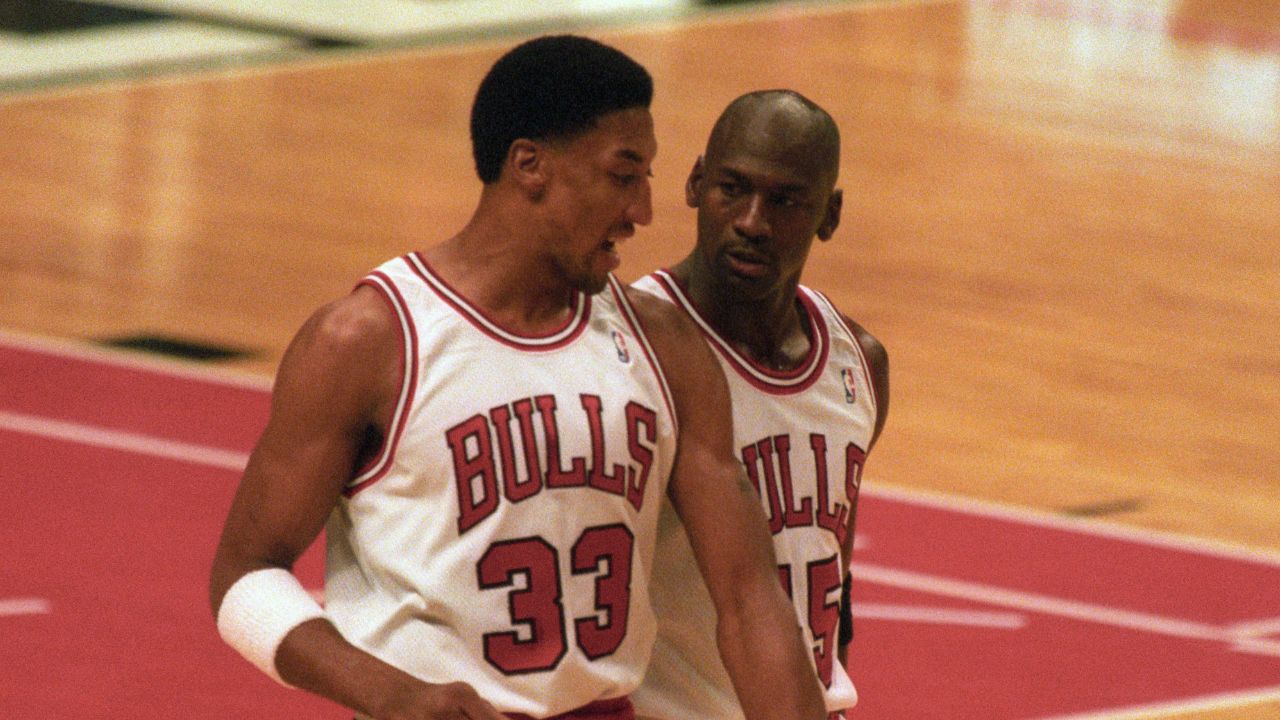
Michael Jordan is a private person and a notorious recluse from the media. And many would have noticed, and criticized even, the Chicago Bulls legend’s reluctance to take political stances, or convey beliefs. His famous line, “Republicans buy sneakers, too,” is possibly the most political Jordan has ever got. And those words were spoken in an unabashedly apolitical context. Speaking on Patrick Bet David’s podcast recently, Scottie Pippen revealed why Jordan maintained this inertness.
According to his running mate, Jordan stayed away from political talks or endorsements largely to protect his brand image.
“He stays away from that. He’s a basketball player. He’s not a politician. He’s not one that’s gonna get involved in any kind of debate. He’s gonna focus more on playing basketball and what it takes to win championships and that’s all he’s gonna speak on,” said Pippen.
Pippen’s words corroborate what Jordan’s “sneakers” comment conveyed about his nature. Jordan had stated it during North Carolina’s State Senate race in 1990 — between Jesse Helms and Harvey Gantt. The NBA legend’s mother had asked him to endorse the Democrat Gantt. Jordan refused, claiming he didn’t know enough about the politician to attach his name to him.
It is not known whether Jordan’s refusal had a bearing on the result. But Gantt lost to Helms, who was re-elected.
And that’s not the only time MJ has abstained from talking politics or taking a stance.
Ahead of the 1991 NBA Finals, former teammate Craig Hodges once asked Jordan and Magic Johnson to boycott the opening game after the infamous Rodney King beating.
Jordan refused to boycott the 1991 Finals
When the Lakers and the Bulls met in the Finals in 1991, it was touted as a legendary matchup. Jordan vs Magic was a blockbuster after all. But for Hodges, the Bulls’ sharpshooter, the presence of the two biggest names in basketball meant more.
Three months before the matchup, King, an African American man, was beaten brutally by four white policemen in Los Angeles. Hodges wanted the two superstars to join him in protest.
“We would stand in solidarity with the black community while calling out racism and economic inequality in the NBA, where there were no black owners and almost no black coaches despite the fact that 75% of the players in the league were African American,” Hodges had said at the time.
Both Jordan and Johnson refused to do so, and the game progressed as usual. Two years later, Hodges was blackballed from the NBA for his outspoken political views.
About the author

-
Amulya Shekhar •
‘Victor Oladipo is leaving Pacers’: Celtics’ Gordon Hayward could move to Indiana with Pacers star wanting out
-
Arjun Julka •
“Embrace the moment when you join the Lakers this summer”: Jamal Murray hints towards joining forces with LeBron James and Anthony Davis in LA
-
Advait Jajodia •
“It’s one of the biggest NBA Finals travesties that Stephen Curry didn’t win the 2015 FMVP”: Chris Broussard makes the case for the Chef being robbed of Finals MVP
-
Terrence Jordan •
“Greatest Thing Ever”: Reliving His Journey as a Grandfather, Charles Barkley Thanks Ernie Johnson for Fascinating Title
-
Nickeem Khan •
Napheesa Collier Reveals WNBA Commissioner Cathy Engelbert’s Comment About Caitlin Clark’s $16M Endorsement Deals
-
Nickeem Khan •
“Pump the Brakes”: Former NBA Champions Aren’t Sold on Warriors Trading Jonathan Kuminga for Jimmy Butler