


Why Are F1 Drivers Weighed After Qualifying and the Race?

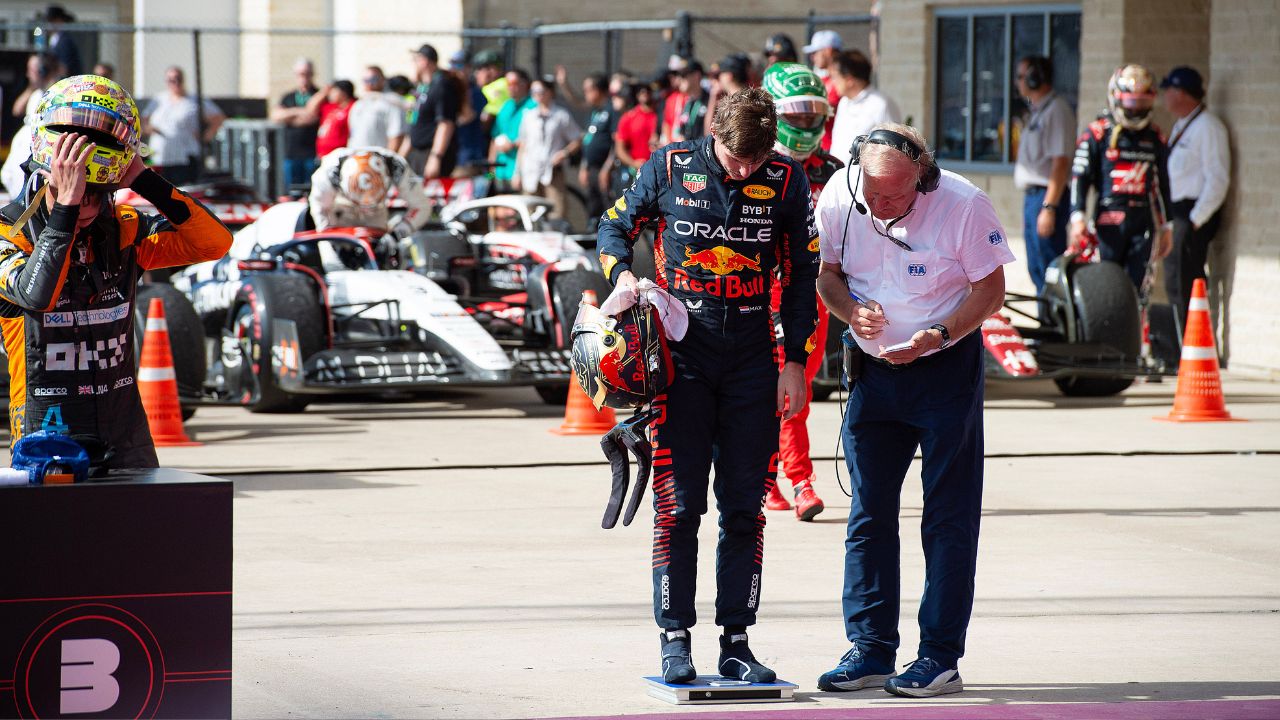
After an exhausting and nerve-racking qualifying session or a grueling race, the first thing drivers would love to do is catch their breath. But almost immediately, FIA officials approach them, asking them to step onto a weighing scale. This routine applies to all drivers, regardless of whether they’ve finished first, last, or even crashed out of the race.
Weight is crucial for speed in F1. Being even slightly overweight can slow down the lap times put in, undoing the work of all the engineers back at the factory. For this, drivers work year-round to ensure they’re in tip-top shape.
They follow an extreme diet as well, with Lewis Hamilton underscoring its importance in an interview two years ago. “If I’m one kilo overweight, I can lose up to two seconds in the race distance…”
But that’s not the only reason drivers keep their weight in check. They also do so to adhere to the FIA’s regulations, as failing to meet them can have severe consequences.
Drivers, including their full race gear—helmets, gloves, and more—must weigh at least 82 kg (181 lbs). And the total combined weight of the car and driver must be at least 800 kg (1,764 lbs). After a qualifying session or a race, drivers are required to step on a scale to have their weight checked, along with the weight of their cars.
If either falls below the stipulated limits, drivers can face disqualification—something that has happened as recently as 2024. At the Belgian GP, George Russell’s car was found to be 1.5 kg (3.3 lbs) below the limit. While this wasn’t directly linked to the Mercedes driver’s weight, it still had to be measured, ultimately bringing the overall weight down.
In case a driver’s weight is below the limit, teams are usually prepared. They simply add padding to ensure they meet the 82 kg (181 lbs) benchmark.
How weight limits in F1 have changed?
The minimum weight limit in Formula 1 has changed throughout the sport’s history. Until 2024, the total minimum weight was 798 kg (1,759 lbs), but the FIA approved an increase of 2 kg (4.4 lbs) for the new season. In 2026, when the regulations reset once again, it will go down to 768 kgs.
For drivers, the minimum weight was previously set at 80 kg (176 lbs). However, to provide a fairer balance for taller drivers, the FIA raised the limit to 82 kg (181 lbs).
F1’s minimum car weight limit over the years ️️
A Thread pic.twitter.com/Z9VayHOZLa
— FORMULA ADDICT (@Formuladdict) October 22, 2024
F1 drivers must maintain a strict weight throughout the season, balancing muscle gain and endurance training while adhering to the 82 kg (181 lbs) minimum. Those under the limit use weighted inserts, while taller drivers manage muscle mass to stay within regulations.
Evidently, being an F1 driver isn’t just about having talent behind the wheel. Even the finest margins can alter the course of a race and in some cases, seasons.
About the author


-

Anirban Aly Mandal •
Ex-Ferrari Insider Slams Team’s ‘Unprofessional’ Management for Triggering Lewis Hamilton in Miami
-

Somin Bhattacharjee •
Valtteri Bottas Ready to Compromise on His Self Promise for 2026 F1 Drive
-

Vidit Dhawan •
Hateful Messages Against Charles Leclerc’s Girlfriend Alexandra by ‘Jealous Females’ Called Out by F1 Photographer
-

Samnur Reza •
Which NFL Team Does F1 Champion Lando Norris Support?
-

Anirban Aly Mandal •
Jarno Trulli Cites Michael Schumacher’s ‘Triumphs’ as the Reason Why He Never Got to Race for Ferrari
-

Anirban Aly Mandal •
“I Was Disgusted”: UFC Star Ciryl Gane Shares Feelings on Esteban Ocon’s Crash That Lost Him Alpine Seat