


How Do NASCAR Cars Refuel During a Race? Why Can’t Formula 1 Cars Do the Same Anymore?

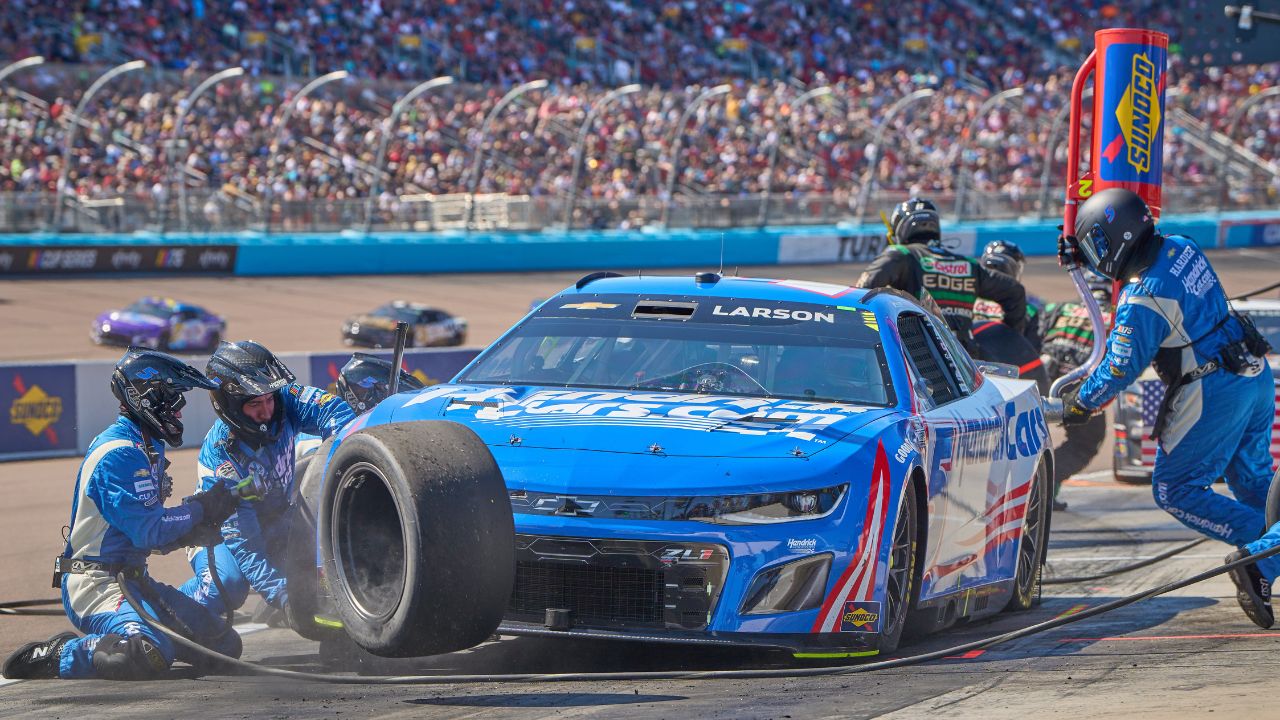
Refueling the cars mid-race is a key strategy employed in NASCAR and often becomes a crucial factor between winning and a DNF from the race without any fuel in the car. During the races, drivers come into the pits to receive a fresh set of tires and additional fuel to carry on.
But in order to maintain maximum strategic efficiency, the amount of time spent in the pits is a crucial factor for the teams as well as the drivers. Hence, in an effort to make sure that not a single extra second is lost, the cars dive into the pits with the engine running and get their refueling done.
The way this is made possible is with the use of something known as a dump can. These things can hold up to 12 gallons of fuel and are designed to literally dump all of their contents within eight seconds. Plus the pit crew members are highly trained and are made aware of the amount of fuel to be added to each racecar.
Most of the time, when the car is in for a short stop, a single dump can is used. However, in order to completely fill a Cup Series car they usually require the use of two dump cans. Even with all of this in place, there can be a possibility of a fuel spill, but the pit crews are usually prepared for that with a set of fire extinguishers nearby. This is how NASCAR Cup Series cars are able to take on fuel during a race. But why isn’t this the case in Formula 1 anymore?
Why can’t Formula 1 cars refuel during a race?
There used to be a time in Formula 1 when teams had to consider the fuel intake as a part of their pit strategy. But since the ruling in 2010, the act of refueling cars mid-race has stopped. Why did this happen?
Well, the primary concern was safety and there were of course other reasons as well. Back in the day fuel tanks used to be smaller and only with the regulation changes in 2010, did the car allow for a slightly bigger fuel tank to be installed. Over the years, there have been several incidents of pit mishaps. But the most notable one was when Jos Verstappen’s (Max Verstappen‘s father) Benetton caught on fire during the 1994 German Grand Prix.
Aside from the general safety issues, there was also the factor of cost cutting which came into play. Hauling around heavy refueling equipment and flammable materials across the globe for each Grand Prix was an expensive affair for the teams.
All in all, the decision was made to ban refueling altogether. Looking into the future, it’s highly unlikely that refueling will ever be reintroduced in the sport owing to its safety and cost concerns, especially in the era of cost caps and budget restrictions.
About the author


-

Somin Bhattacharjee •
American F1 Civil War Ensues as Haas Boss Smack Talks Andretti Entry
-
Tanish Chachra •
“Not the final push”– Lewis Hamilton banters against Max Verstappen on Instagram
-

Somin Bhattacharjee •
“Cristiano Ronaldo meeting Carlos Sainz and Charles Leclerc”- Throwback to when the Manchester United star met the Ferrari duo at Fiorano
-

Somin Bhattacharjee •
Lewis Hamilton Still Sends Gifts to Nico Rosberg’s Daughters Despite Past Enmity
-
Utkarsh Bhatla •
F1 teams oppose the ban of virtual garages
-

Tanish Chachra •
“That was what was playing on my mind”– Mercedes ex-technical director on why he stepped down